
This article is a working method, not legal advice. The laws covering image rights and privacy differ from country to country, and on subjects that could expose someone to real harm you consult a qualified party before filming rather than after publishing.
The man sat in front of the camera and talked for twenty unbroken minutes. A complete account, with detail the filmmaker would not have got from anyone else. And at the end, while unclipping the mic from his shirt, he said one sentence: please, do not show my face.
The filmmaker went home, put a blurred rectangle over the face in the edit, and published. Two weeks later a message arrived: three people from the man's town had recognised him. Not from the face, but from his voice, from a ring on his hand that appeared in a close shot, and from a sentence in which he named the factory where he works.
That is the basic error in this whole area: hiding an identity is not an operation performed on a face in the edit. It is a decision taken before you press record, and it covers everything that points to the person.
Before anything else: ask about the risk
Before you choose a filming method, ask the person one direct question: what happens to you if people recognise you?
The answer changes everything that follows. There is a difference between someone holding back because he is shy or because his family dislikes being seen, and someone who could lose his job or face a threat to his safety. In the first case a good filming method is enough. In the second you revisit the whole idea: is the film worth putting a person at that risk? And could the story be told from another source that does not pay that price?
And do not promise what you cannot guarantee. Do not say "nobody will know it is you". Explain exactly what you will do, what possibility remains, and let him decide. Real consent rests on understanding, which is what we covered in Filming Other People: How to Ask Permission and Respect Their Privacy.
Six methods decided before filming
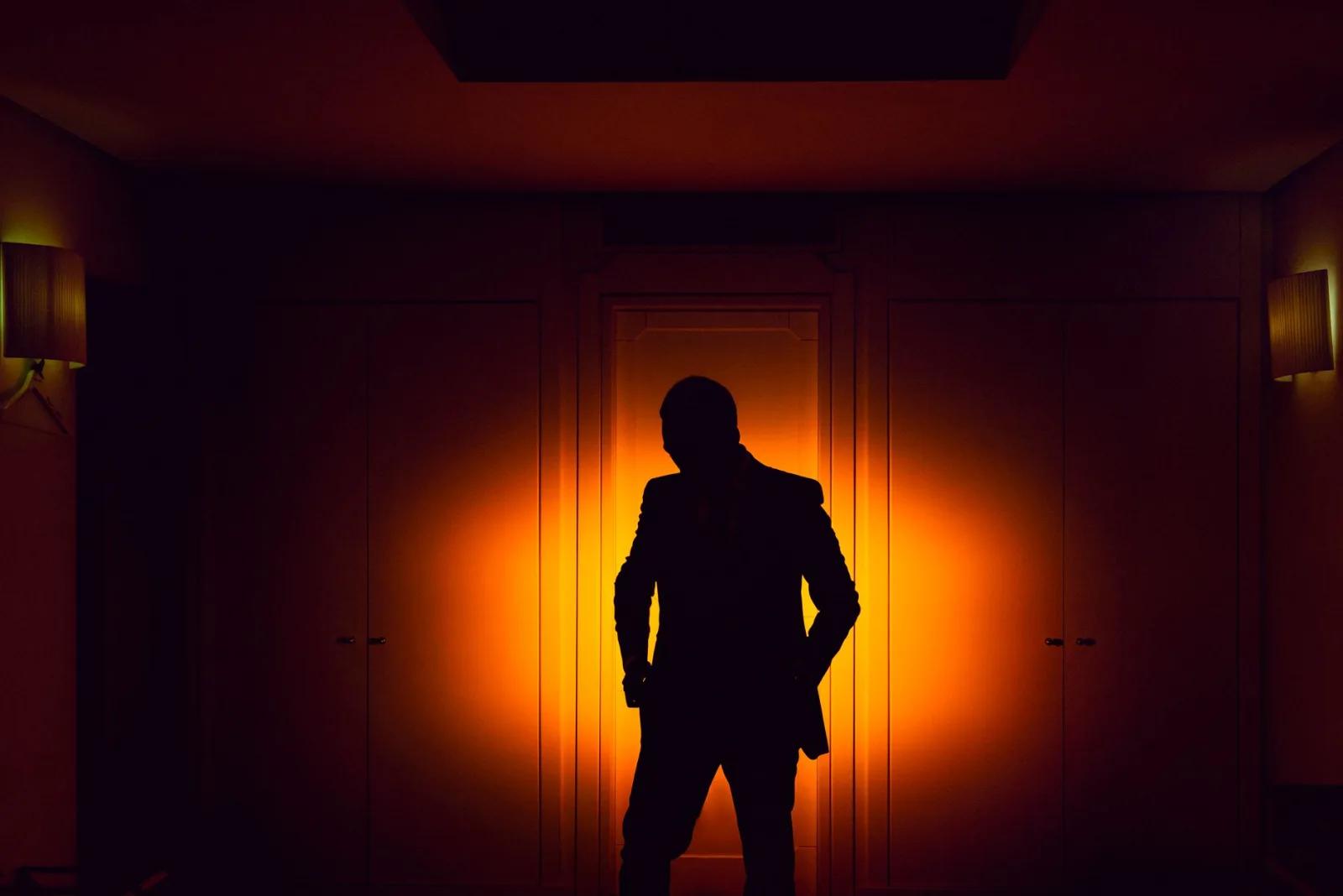
1. Silhouette against the light. The strongest method visually and the cheapest. You put the light source behind the person, a window or a lamp, and shoot from the opposite side, so he comes out as a black shape with clear edges against a bright background. You need to pull the camera's exposure down so it does not try to recover the features. The principle of light direction here is the same as in Lighting in Filming: From a Single Source to Three-Point Setups, used in reverse.
2. The cropped frame. Keep the face out of the frame from the start. The hands moving as he talks, the shoulder and part of the neck, the feet on the floor, his shadow on the wall. These shots are more honest than a blur, and they carry visual value of their own.
3. Voice over shots of the place. You record the testimony as clean audio and lay it over shots of the house, the street, the workplace, with the person never appearing. The safest method of all; it loses some presence, which you make up for by making the shots of the place strong.
4. A visual screen. Ribbed glass, a thin curtain, a window with condensation on it, a mesh, between the camera and the person. It gives the sense of presence without features.
5. The back and the walk. The camera behind the person as he walks through his place or works. Useful in films with movement in them, and not safe on its own, because posture and clothing point to a person.
6. Extreme shallow focus. The person completely out of focus with a sharp foreground. An elegant method and the weakest for safety, because image enhancement may pull something back. Do not use it alone on a subject where there is risk.
What gives identity away apart from the face
Run this list over every shot and over the audio before publishing:
| The clue | How it is handled |
|---|---|
| The voice | Shifting the pitch slightly in the edit, or having someone else read the words aloud while telling the viewer so |
| A tattoo, a mole, a ring, a watch, an injury | Kept out of the frame during filming, not blurred afterwards |
| Distinctive clothing | Ask him to change, or shoot from an angle that does not show it |
| A recognisable background | A plain wall, a borrowed room, or a shot at night |
| The name of the place, the job, the number of years | Removed from the speech itself, or replaced with a general description |
| Plaques, numbers and certificates on the wall | Taken off the wall before filming |
| File names and clip metadata | Checked at export, since file data carries location and date |
The striking thing about most of these incidents is that the face was never what gave it away. It was one sentence in the speech, or a small thing in the frame that nobody in the edit room noticed.
Why blurring in the edit is the last resort
Blurring and pixelating look like the easy answer, and they carry three problems. The first is that they rely on tracking that fails for a moment, so the face appears for two frames. The second is that a blurred rectangle over a face carries an implication of crime and accusation, an implication most people asking for anonymity do not deserve. The third is that they fix nothing on the list above.
The rule: make the shot safe in the camera, and use the edit for correction rather than rescue.
The voice is a question of its own
Altering a voice with a harsh robotic pitch shift ruins a testimony and turns a human being into an object. The alternatives are better:
- Lowering the pitch slightly without overdoing it, which is enough in many cases.
- Having someone else read the exact written words, with the viewer told so on screen. This is more honourable than distortion and clearer.
- Written subtitles alone over shots of the place, with no original audio.
Condensing long speech into a few minutes without distorting it is covered in Editing an interview: how do you cut an hour of talk to ten minutes without distorting it?, and it matters more here, because the person cannot defend himself after publication.
Consent in this case
The usual release form is not enough. You need to add three things to it:
- A written description of the agreed method of concealment, so the agreement is not a verbal one that gets forgotten.
- The person's right to see the clip he appears in before publication.
- What happens if he withdraws his consent: what you can actually remove, and what passes out of your hands once published. Say this plainly from the start.
The core items of a release form are in The release form: what goes in a filming permission form?.
Storing the raw material
The point everybody neglects. The original file holds the face and the voice in full, and it is the most dangerous thing on your computer.
- Do not upload it to a shared service open to a whole team.
- Do not keep it in the ordinary project folder that moves between machines.
- Agree with the person on what happens to the raw material once the film is finished: kept or deleted?
- If you work with an editor or a translator, tell them this material has a special status.
And finally: your own limit
There is a situation that happens to everyone working in this area: an excellent testimony, a person eager to give it, and a real risk to him that he is not weighing well in the heat of the moment.
In that situation you are not merely a conduit. You have the right, and perhaps the duty, to postpone, to decline, or to tell the story another way. The rule governing this area is the same one governing Filming in sacred and sensitive places: no shot is worth paying for with a person's safety or dignity.
A film where you lose a scene and keep a person safe is the better film.