
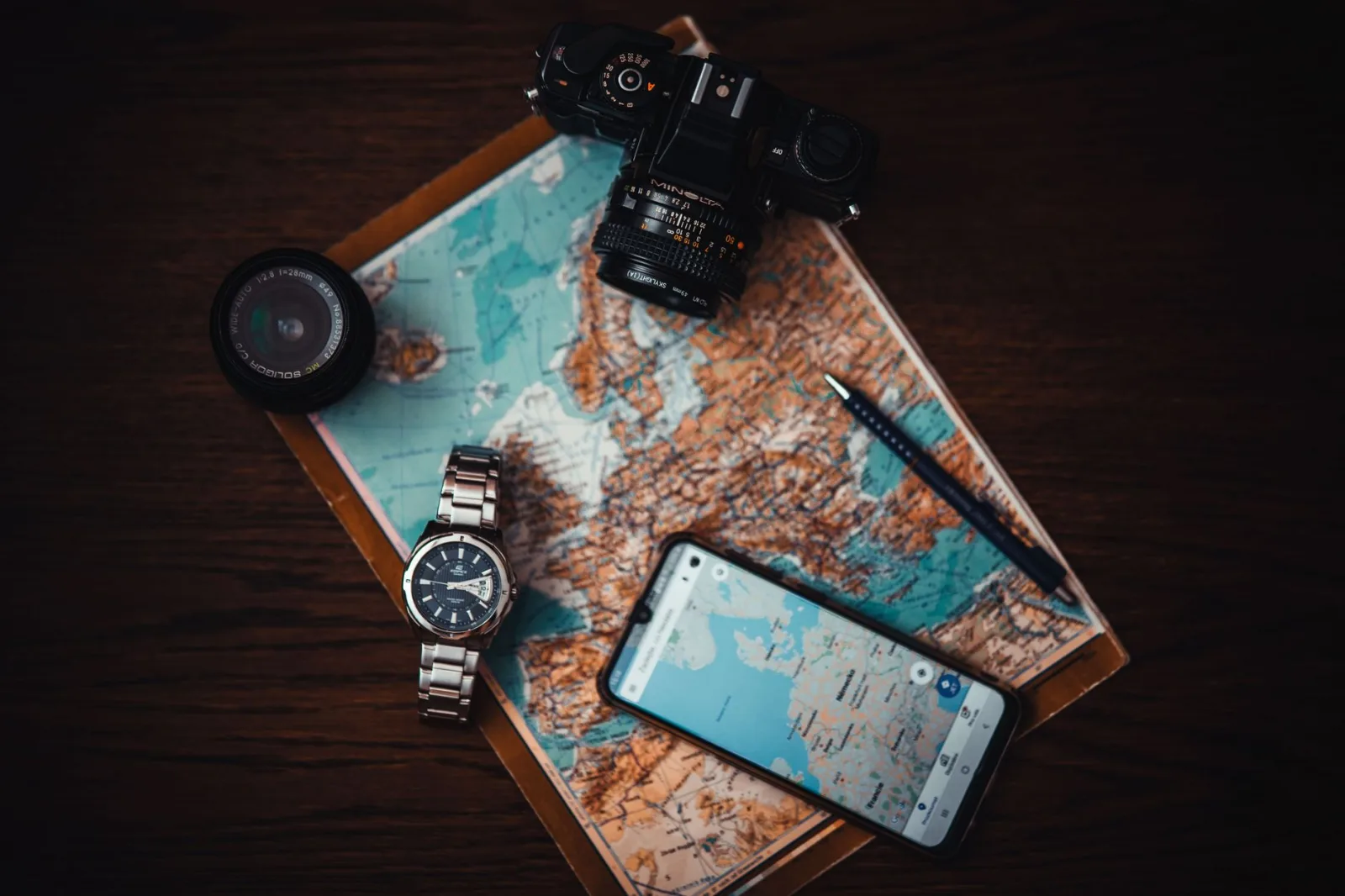
He reached the location at three in the afternoon and found the sun on the side that puts faces in shadow. Then he reached for his shot list and found it was a sheet of paper left on his desk. And during the interview the camera's microphone failed, so he recorded sound on the camera itself, and it came out distant and full of room echo.
His phone could have solved all three of those, and it was in his pocket.
On a shoot day a phone is not just a spare camera. It is a production tool: it calculates, records, reads, displays and transfers.
Six kinds, not six names
Apps change, disappear and get renamed. What is useful is knowing what to look for rather than memorising a name:
| The kind | What it solves |
|---|---|
| A manual camera | Locking exposure, shutter and white balance |
| A backup audio recorder | A second copy of the sound that rescues an interview |
| Light times and sun direction | Knowing sunset and where the light falls before you go |
| A teleprompter | Text scrolling in front of you while you speak |
| Shot list and voice notes | The day's plan in your pocket, nothing forgotten |
| File transfer and backup | Getting material off the card into two places |
1. A manual camera
A phone's native camera app decides for you: it shifts exposure as you walk and changes white balance between shots. A manual camera app lets you lock all three so the picture stays consistent.
What you lock: exposure, shutter at double the frame rate, white balance, and focus. Those numbers are detailed in the resolution and frame rate article and in exposure basics, and the phone's full limits are in Can You Create Professional Content With Just a Phone?
2. A backup audio recorder
This is the most useful app on the list. Put the phone in the pocket of whoever you are interviewing, or on the table near them, and start recording with every interview.
In the edit you sync the two tracks with the clap you make at the start of every take. And if the camera's mic fails or the sound comes out distant, you have a second copy that saves the film.
Never trust a camera's built-in mic on an important interview, and never record a single interview from a single source.
3. Light and sun
An app that tells you sunrise, sunset and the sun's direction at a given hour in a given place. Using it the day before saves you two hours of hunting for shade.
It is what makes you write in your schedule: the exterior scene two hours before sunset, the interview at midday indoors. That is the logic of splitting the day in The shooting trip schedule.
4. A teleprompter
Text scrolling on the phone's screen at a speed you set. Its use is in instructional videos and in sections full of figures and names.
Two rules for using it: put the phone close to the lens rather than off to one side so your eyes do not look adrift, and write points rather than full sentences if you are speaking naturally.
5. Shot list and voice notes
A shot list on your phone means you forget nothing and carry no paper that soaks in the rain. Tick each shot as you get it.
And a voice note is faster than writing on location: after every scene, record one sentence about what happened and what is missing. That is what turns four hundred clips into ordered material.
How to derive the list from your script is in From Script to Shot List.
6. Transfer and backup
In the evening, the phone copies from the card to a drive or to cloud storage, giving you a second copy before you even reach your computer. With a small card reader that takes minutes.
That is the item that protects your whole day, and the card and battery arithmetic that goes with it is in Batteries and memory cards: what to actually buy.
Four extras when travelling
- Maps that work offline. Download the whole area before you travel.
- An offline translator. For short exchanges with whoever is helping you.
- A level and a ruler. For levelling the horizon and measuring tripod distance.
- The camera monitor app. The manufacturer's app shows you what the camera sees, which matters most to anybody filming themselves, as in How do you film yourself alone?
Rules that make the phone help rather than hinder
- Test every app once before the shoot day. An app you download on location takes half an hour of your time.
- Flight mode or do not disturb on every shoot. A notification ruins a take and interrupts an interview.
- A power bank. The phone drains fast while recording, displaying and keeping the screen on.
- Clear space before you leave. Not after it fills up mid-interview.
- One app per job. Three manual camera apps on your phone make you hesitate at the wrong moment.
And do not ask more of it than it can carry
A phone solves problems; it does not solve everything. It does not replace a close mic in wind, or a tripod at night, or a light in a dark room.
Use it for what it is good at: calculating, backup recording, displaying, transferring and reminding. And you will find that half of what you carry in the bag was already in your pocket.