
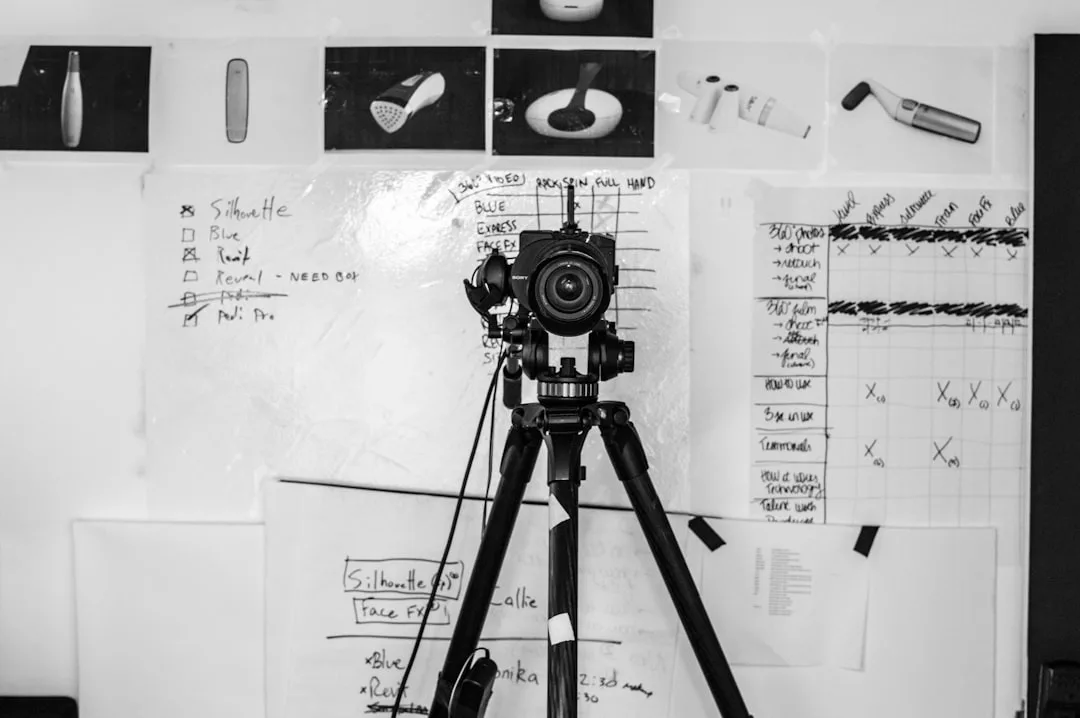
The Discovery That Came Too Late
He came back from the trip with a lot of footage, and sat down to assemble the film.
The first chapter went well. So did the second.
On the third he stopped.
The voiceover was talking about the old trade and how it's learned, and he didn't have a single shot of anyone learning it. He'd filmed the man working, and he'd filmed the place, and he hadn't filmed the teaching itself.
So he laid a general shot of the market over the words.
Then in chapter five the same thing happened, so he laid down another general shot.
By the end there were seven minutes of speech in the film sitting over images that had nothing to do with what was being said. And the viewer feels that even if they can't name it.
And the location was a three-hour flight away.
All of it would have shown up on paper before he travelled, had he written one line in front of every card: what image carries these words?
The Problem the List Solves
A script says what will be heard, and doesn't say what will be seen.
A shot list moves that discovery from the edit suite to your desk, where fixing it is free.
How to Derive It From the Script
Read the script cards one by one, and ask of each: what image makes these words comprehensible? Then record a row for each card carrying:
The shot type: wide to establish the place, medium to follow the action, close to show detail or emotion.
The subject: what specifically appears in the frame. Not "a shot of the market" but "the seller's hands weighing the goods".
The location and time: where, and at what hour of the day, because some shots only work in a particular light.
The priority: essential, without which the film doesn't stand, or supplementary, filmed if there's time.
The Coverage Rule
For every main scene, film at least three shots: wide, medium, and close. This isn't a luxury, it's insurance: it gives you freedom to cut in the edit, and it saves you when a shot is ruined or a passer-by walks through it.
And the complementary rule: film longer than you think. A shot that needs four seconds in the script needs ten in the edit, because the start and end usually get trimmed.
Shots the Script Never Mentions and You Always Need
Linking shots: small details that bridge two scenes, like a hand opening a door, a sign, a pair of feet walking.
Ambient sound: record a minute or two of the location's sound alone with no speech. You'll need it in the edit to fill audio gaps.
Alternates: the same shot from a second angle. It costs one minute on location, and it's worth a great deal when the first one fails.
Order the List by Location, Not by Script
This is the most practical point: the script is ordered by narrative, but filming must be ordered by place.
Group every shot filmed at one location together even if they're far apart in the film, so you shoot them in one visit instead of returning to the place three times.
And this dual ordering is a good reason to keep the list inside the video project next to the script: you see both versions, the narrative order and the filming order, and move between them, as in the project approach explained in: managing content production projects.
The Final Review Before You Travel
This is the step that would have saved our friend.
Go through the script cards one last time and make sure every card has at least one matching row in the list.
Any card with no image gives you two options: find it a shot, or delete it from the script. And usually deletion is the right decision, because words without an image behind them weaken the film even when they're true.
And if a shot you hadn't thought of appears on location, record it immediately as a note on the relevant card before you forget it, as in: voice notes in Bardiyah: capture an idea before you lose it.