
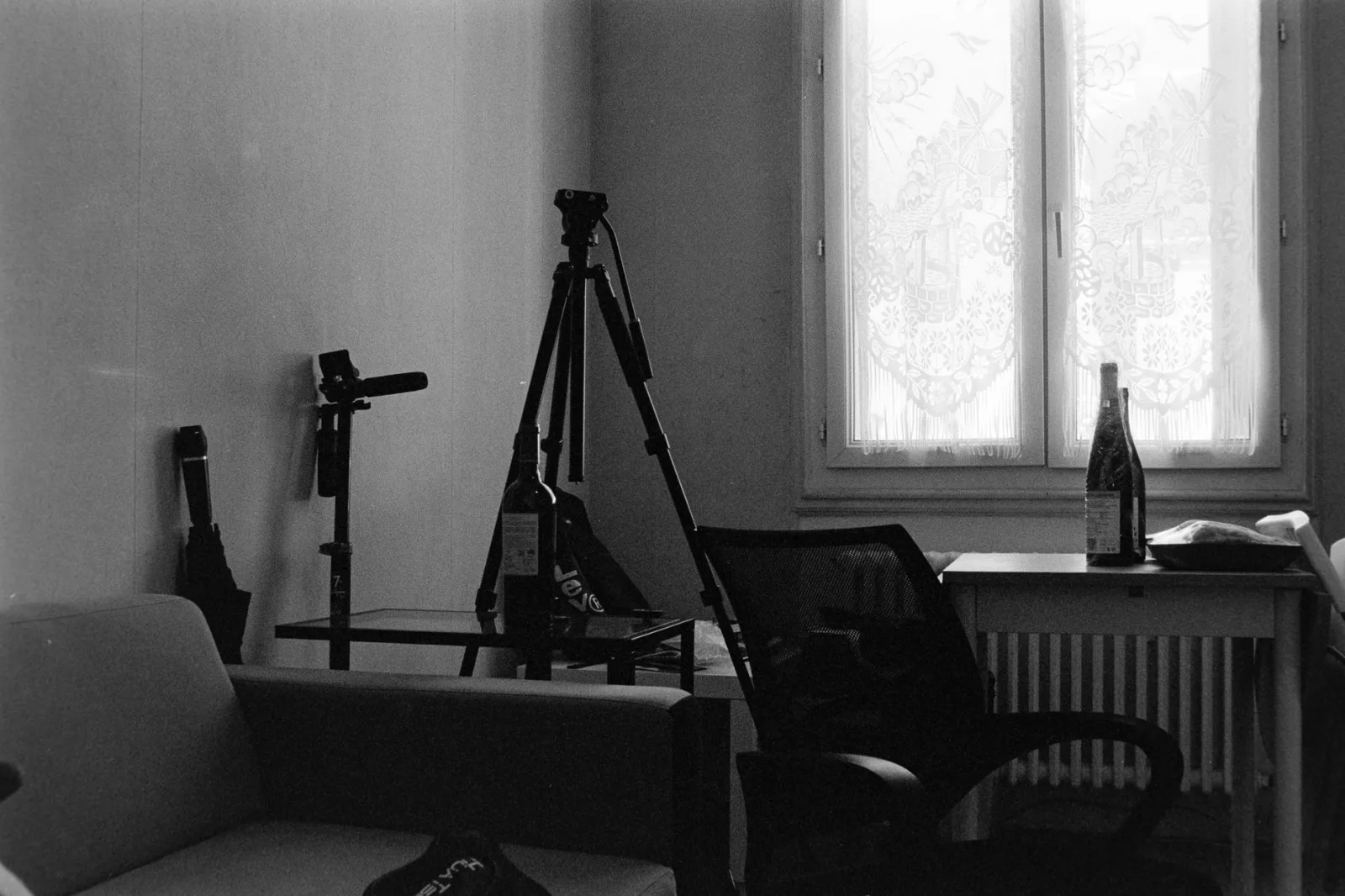
He set up the room, set the camera, sat down and talked for forty minutes without stopping. He was happy with what he said.
Then he opened the file on his computer and found three things: the frame cut off the top of his head, the focus was set on the wall behind him rather than on his face, and the mic had been at the far edge of the table, so the sound came out as though he were in another room.
Forty minutes gone, and the fault was not the gear. The fault was that he was filming something he could not see.
The real problem: you are outside the frame and inside it at once
Somebody filming another person watches the screen while filming and corrects in the moment. Somebody filming themselves sits where they can see nothing, trusting that what they set five minutes ago is still right.
Everything in this article solves that one problem in two ways: either you see, or you lock down what you cannot see.
Seeing: four solutions at four prices
- A screen that flips forward. If your camera has one, that is the easiest answer.
- A phone showing the camera's view. Most modern cameras connect to an app that mirrors the image; put the phone in front of you outside the frame.
- A mirror behind the camera. An old, cheap trick: a small mirror reflecting the camera's rear screen.
- A fifteen-second test take. Free and always works: sit in your place, record fifteen seconds of yourself talking, stand up and watch it, then begin.
The fourth is what to recommend to anyone who does not want to buy anything. Fifteen seconds reveals a mistake that would cost you forty minutes.
A mark on the floor
This is the most useful physical move in the article, and with it most focus and framing problems end.
Put a mark where you sit or stand: tape on the floor, or a cushion in a fixed position on the chair. Then set focus on that mark while you are standing in it, and switch off autofocus.
Focus is now fixed and cannot drift, and you return to the same mark every time. The causes of softness are set out in Focus: why do your shots come out soft, and how do you fix it?
And do not trust autofocus while alone unless your camera tracks eyes reliably, and even then test it with fifteen seconds first.
A seven-item checklist before every take
| Item | What you check |
|---|---|
| 1 | Framing: your whole head with a small gap above it |
| 2 | Focus set on your mark and locked |
| 3 | The mic close to you and in position |
| 4 | The audio meter is showing and moving |
| 5 | Battery and card space cover twice what you will record |
| 6 | Light from the side rather than above your head |
| 7 | The background: nothing distracting and nothing private visible |
Print it or write it large and stick it behind the camera. The item people drop is the fourth, because they look at the picture and never at the audio meter.
Framing while alone
One simple rule is enough: put your eyes in the upper third of the frame, and leave a small gap above your head, neither large nor none. And if you talk with movement, pull the camera back a little, because a tight frame means any movement takes you out of it.
The rest of the rules for placing a subject in frame are in Composition and Framing: Where to Put Your Subject in the Frame.
Sound while alone
A clip-on mic on your clothes is the best answer for anyone filming themselves, because it moves with you so the level does not change. If you have one mic that sits on the table, keep it a hand's width or two from your mouth and out of frame.
And before buying, the room matters more than the mic, as in The Room Comes Before the Microphone. The difference between recording in a room with a rug and curtains and recording in an empty room is larger than the difference between one mic and another.
One small habit saves everything: clap once in front of the camera at the start of every take. If the audio fails you know it failed from the first second, and if you record on a separate recorder you now have a mark to sync picture and sound.
Lighting while alone
Put the window or your lamp to your side, sit in your place, and look at the picture in a test take. If you are filming a series across different days, film at the same time of day so the light stays consistent.
Indoors with no window, locking your settings manually protects the picture from shifting between shots, and the relationship between aperture, sensitivity and shutter is in Camera Basics and the Exposure Triangle.
Outdoors and alone
- A small stand and some weight. Your bag on the stand's base stops it going over in wind.
- Do not leave the camera and walk away. Film from a distance you can see it from, and in crowded places keep somebody you know near it.
- A mark in the place. A stone or a water bottle that tells you where to stand.
- Record sound separately if the place is noisy, because close sound matters more than a distant picture.
The moving-shot exercise
If you want to move in frame, do not move at random. Put two marks: where you start and where you end. And set focus on the second mark if your important line lands there.
Then film the move twice: once full and once short. The short one is what rescues you in the edit.
Save your time: film several videos in one session
The heavy part of filming alone is the setup, not the recording. So once everything is set, use the setup for more than one video, changing your shirt if you want a visible break between them. The full method is in How to Film a Whole Week's Content in One Day.
Write your setup down once
At the end of a successful session, measure three numbers and write them down: the distance between chair and camera, the stand's height, and the lamp's position. Then put tape on the floor at all three.
Next time you will not need half an hour of setting up, only five minutes and a fifteen-second test. That is the difference between somebody who publishes weekly on their own and somebody who stalls at every shoot.