
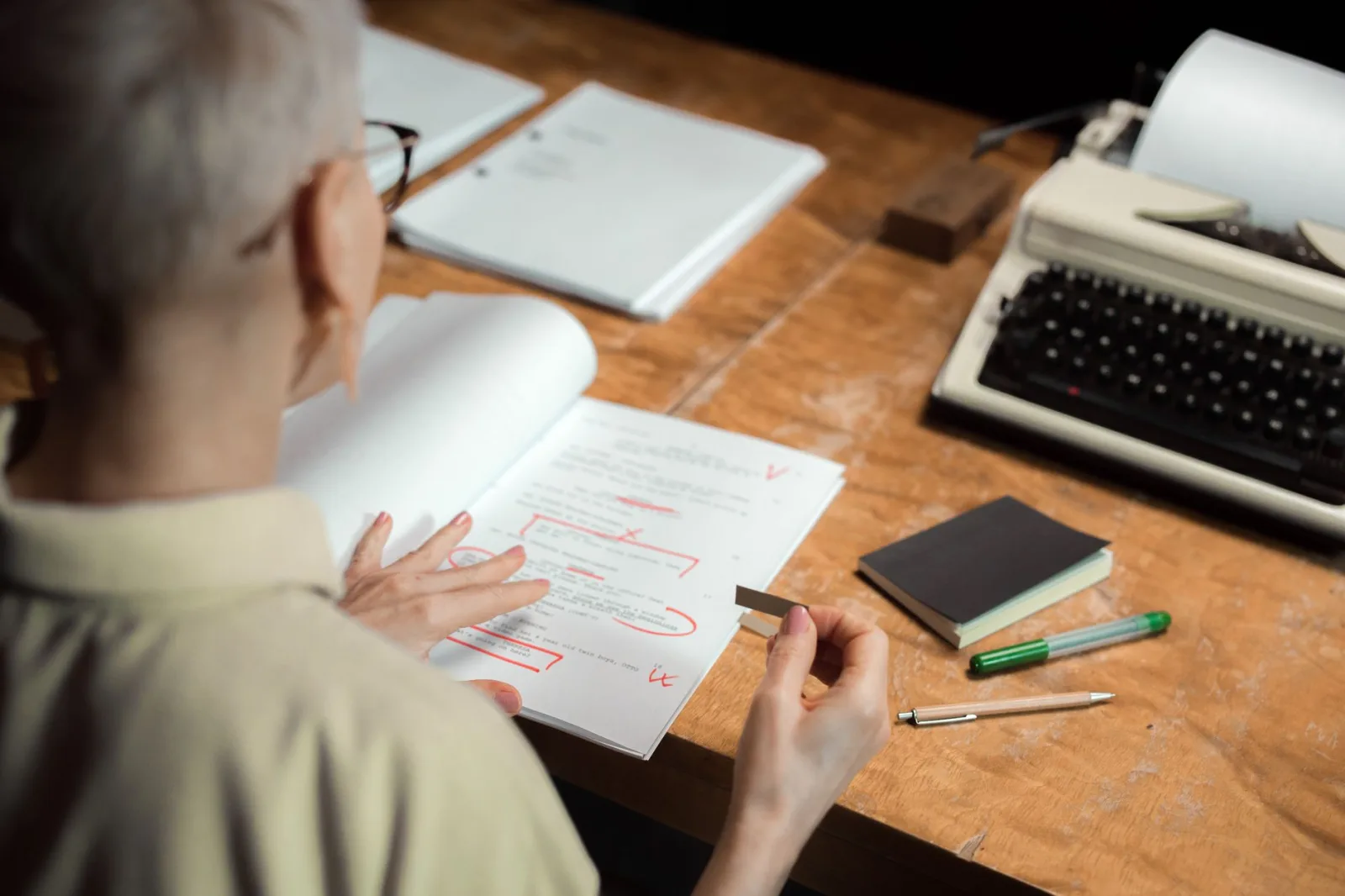
He had a shoot in two days and a script he had not started. So he wrote to the assistant: "write me a ten-minute video script about X."
A tidy text came back in seconds. Balanced paragraphs, smooth transitions, sentences that looked correct. He sat reading it aloud to try it out and stopped on the first page. The text resembled every video he had ever seen, and resembled him not at all. There was not a sentence in it he could say to camera without embarrassment.
So he went back to his own clumsy draft and asked for something else entirely: a review of what he had written. And he came out with a script better than either.
The difference between "write me" and "review mine"
"Write me" gives you the average of what people have written on this subject. Which is precisely what you do not want, because your channel rests on what makes you distinct rather than on what resembles everybody.
"Review mine" works on your material: your idea, your experience, your language. The text stays yours and gets cleaner.
The second difference matters more: in the first you read a text and try to be convinced by it. In the second you read notes and decide for yourself what to take and what to refuse. The decision stays with you, and that is the thing whose loss costs you the channel.
Four separate reviews, not one
The biggest mistake in asking for a review is saying "review this script." The answer will be a mixture of language, structure and factual notes, so you will not know where to start.
Ask for four reviews in four messages, in this exact order, which is the same order as the human review set out in revising a long script: how to cut the excess with a critical eye:
1. Structure. Is the order right? Where does the viewer lose the thread? Which paragraph could be deleted without losing anything?
2. Clarity. Which sentence carries two meanings? Which term did I use without explaining? What will the viewer ask that I never answered?
3. Padding. Which sentences add nothing? Where do I repeat myself? Which paragraph could I say in half its length?
4. Facts. Which figures, names and dates need a source? Ask for a list of them only, and do not ask it to verify them; that is your job.
Each review on its own gives you an actionable list. All four together give you chaos.
Ready-made prompts
Copy and adjust:
This is my script. Do not rewrite it and do not suggest alternative phrasings.
Read it as a structure critic only, and answer three questions:
1. At which point does the viewer lose the thread?
2. Which paragraph could be deleted with no loss?
3. What order would you have proposed for the first four scenes?
This is my script. Act as a viewer, not an editor.
Read the first minute and tell me: what did you understand the video to be
about? What do you expect to see next? When would you have stopped watching,
and why?
This is my script. Extract only a list of every figure, name, date and factual
claim that needs a source. Do not verify them and do not add information. The
list only.
The second prompt is the most useful, because the first minute is where people stop, and its rules are in how to write a strong hook for a YouTube video.
Ask for questions, not edits
This is the strongest move in the whole subject. Say: "do not fix anything, write me ten questions this script should answer and does not."
A question works differently from an edit. An edit hands you a finished sentence to accept or refuse, and most people accept because accepting is easier. A question makes you think and write in your own language, so the text comes out better and stays yours.
The rule: do not accept a sentence you cannot say
Before accepting any suggested phrasing, say it aloud. If it does not feel like your speech, refuse it however handsome it is.
A viewer spots a borrowed sentence at once, even without knowing why. And a video with four sentences that are not yours feels dishonest all the way through.
Give it your context before you give it the script
A review with no context gives you generic notes. Write four fixed lines at the top of the message, keep them, and paste them every time:
- Who my audience is and how much they know about the subject
- The target length of the video
- My tone: how I talk and what I never say
- The one thing I want the viewer to leave with
Those four lines raise the quality of the notes a great deal, and you write them once.
And if your assistant is connected directly to your project, that context is read from your channel file instead of being pasted each time, which is the benefit of a direct connection set out in what is MCP and how to connect AI tools to your project.
What never to delegate in a script
- The hook. The first sentence has to come from your own head, because it is the sentence that most resembles you.
- Your opinion. If the video takes a position, it is your position or it is nothing.
- The joke. A generated joke is recognisable from a distance.
- The last sentence. The closing is what people remember.
- The personal story. Its details exist only with you.
- The decision to cut. The assistant suggests; you delete.
And what genuinely helps outside review
- Explaining a writing principle you do not understand.
- Giving you examples of a structure so you can see it rather than copy it.
- Summarising two hours of an interview recording you conducted yourself.
- Finding the contradiction between two sources you gathered.
And the recurring structural mistakes in scripts, which you should check yourself before any review, are in seven common mistakes in YouTube video scripts.
The final review is still reading aloud
After all the notes, sit and read the whole script out loud. Every sentence your tongue stumbles over is a sentence to rewrite. No assistant performs this check, because it measures one thing nobody else knows: is this your speech?