
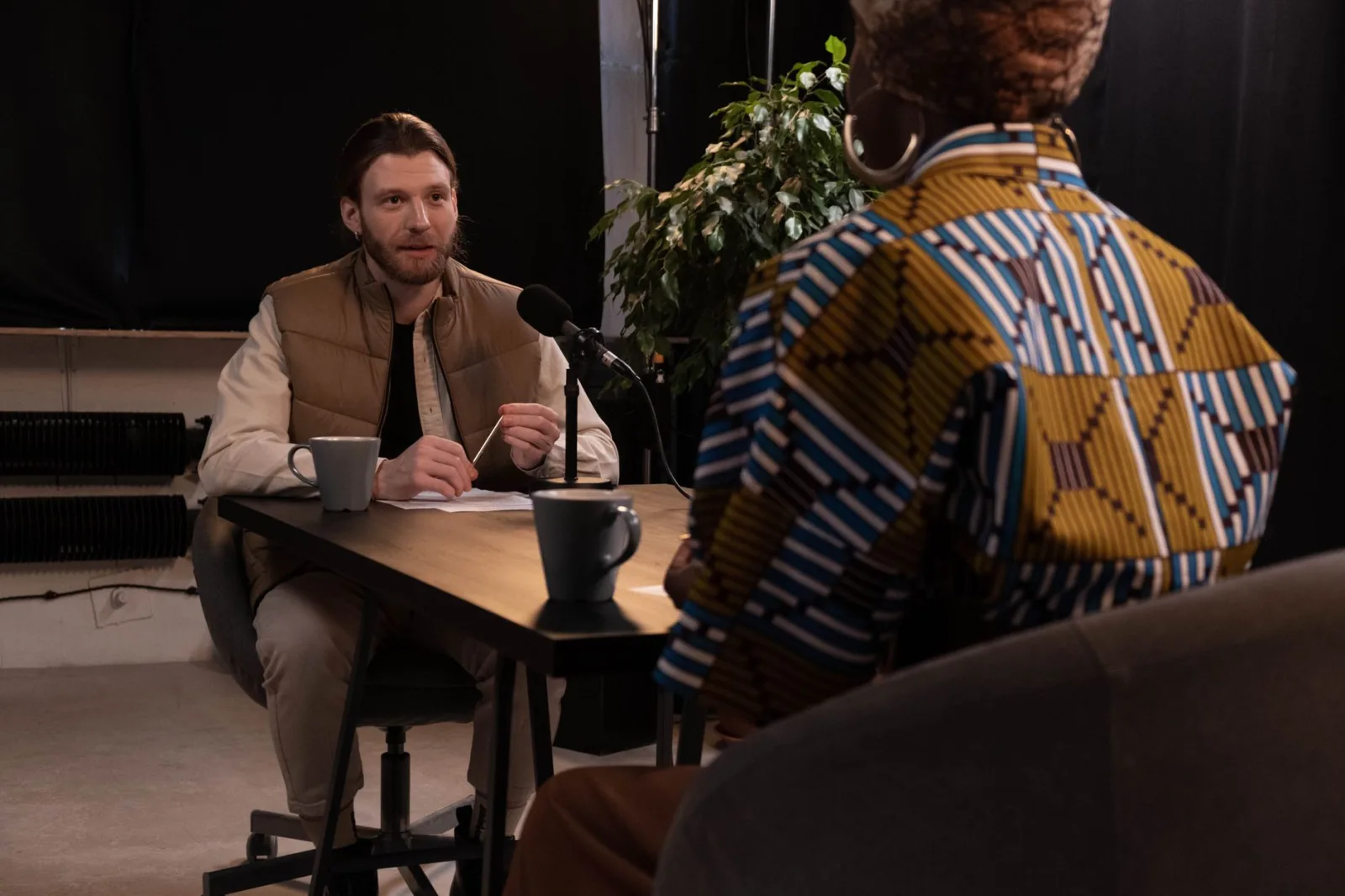
He sent his guest fifteen questions three days before filming, and he thought of it as respecting the man's time. The guest arrived having written out his answers, and read them to him.
The video came out cold: question, answer, question, answer, with no interruption, no laugh, and no moment where anybody was thinking. A friend watched it and said one sentence: "it's like an interrogation."
The second time he sent only four topics with no questions. The guest arrived talking rather than reading, and the video came out the way he had wanted it.
The rule: write a map, not words
In a solo video you write sentences you will say yourself. In a video with a guest you write a road the two of you walk, because half the speech is not yours and should not be put in their mouth.
The map is four stations: where you begin, where you end, the moment you want the viewer to remember, and what they must understand before they hear that moment.
What you write word for word, and what you do not
| Word for word | Only as a heading |
|---|---|
| The hook and first thirty seconds | The guest's answers |
| Introducing the guest in two lines | Your remarks inside the conversation |
| The transition between each pair of stations | Your reactions |
| The closing line and the call to action | Details you will discover in the talk |
The left column is what stops the video expanding without end, and how to write it is in How to Write a Strong Hook for a YouTube Video.
Topics, not questions
What you send your guest before filming is four words, not fourteen questions:
We will cover four areas:
1. How you started
2. The hardest year
3. The mistake people keep making in this field
4. What you would do if you started today
No fixed questions, and we will talk the way we normally talk.
That leaves the guest mentally ready and not verbally memorised. Whoever sends the full questions gets written answers, and written answers are the worst possible material in the edit.
The one exception: if your guest will mention figures, dates or names, tell them in advance so they can check them before filming.
Only open questions work
One open question per station, with three follow-ups in your pocket:
- Open: "How did you start?", "What happened that day?", "Why did you choose this?"
- Follow-up: "And then?", "How did that feel?", "Give me an example."
And the strongest tool in your hand is not a question but silence: ask, then stay quiet for two seconds after the guest finishes. In those two seconds people say the best thing they say, because they assume the answer was incomplete.
A two-minute agreement before filming
Say these things to your guest before the camera rolls, because they raise the quality of the whole conversation:
- We record long and cut it down. So they fear no mistake and apologise for none.
- If you stumble, start the sentence again with no comment, and we will delete the first attempt.
- I will interrupt sometimes, and that is engagement rather than cutting you off.
- Tell me if there is anything you would rather not publish, and I will delete it with no discussion.
The last line matters most. Somebody who knows they hold a veto speaks more freely, and the material that comes out that way is truer.
Who talks more?
A simple rule: if the guest is the subject, your share of the talking is a quarter. If the video is a conversation between two partners, it is half.
What spoils guest videos most is a host who explains his guest's answers after the guest has given them. Your job is to open the road and go quiet, not to summarise what people just heard with their own ears.
Write the transitions before you film
The transition between two stations is what makes the conversation look ordered in the edit. So write yourself a transition line for each station: "Before we get to X, I want to ask you about…"
And if you forget to say it while filming, record it alone after the guest has left. That is the easiest rescue in this kind of video.
What to film after the talking ends
A short list not to forget: wide shots of the place and the seating, shots of the hands, an object or a piece of work the guest talks about, and you listening without speaking. That material is what hides every cut in the edit.
Ways to film it on one camera are in How do you film a conversation between two people with one camera?, and the line-of-action and cutting rules are in The Line of Action and Cutting Rules.
The real writing happens in the edit
In a guest video the final structure is written after filming rather than before: you move an answer from the end of the conversation to the start, delete a whole station, and build a film out of speech given in another order.
The ethics of all that, and what may and may not be deleted, are in Editing an interview: how do you cut an hour of talk to ten minutes?
Five mistakes in guest scripts
- A question list read off a page. Eyes on paper kill a conversation.
- A question containing its own answer. "Wouldn't you agree that…" asks for agreement rather than an answer.
- Two questions in one. The guest answers the second and forgets the first.
- A long introduction of the guest. Two lines are enough; the rest shows in their talk.
- No agreement on duration. A guest who thinks it is half an hour and sits for three will not come back.
The rest of what spoils scripts generally is in Seven Common Mistakes in YouTube Video Scripts.
And after the video
Send your guest the link before publishing if the talk was personal, or afterwards with a short thank-you and copies of the clips featuring them so they can use them too.
That small step is what makes the second guest easier than the first, because people talk about their experience with you more than they talk about your video.