
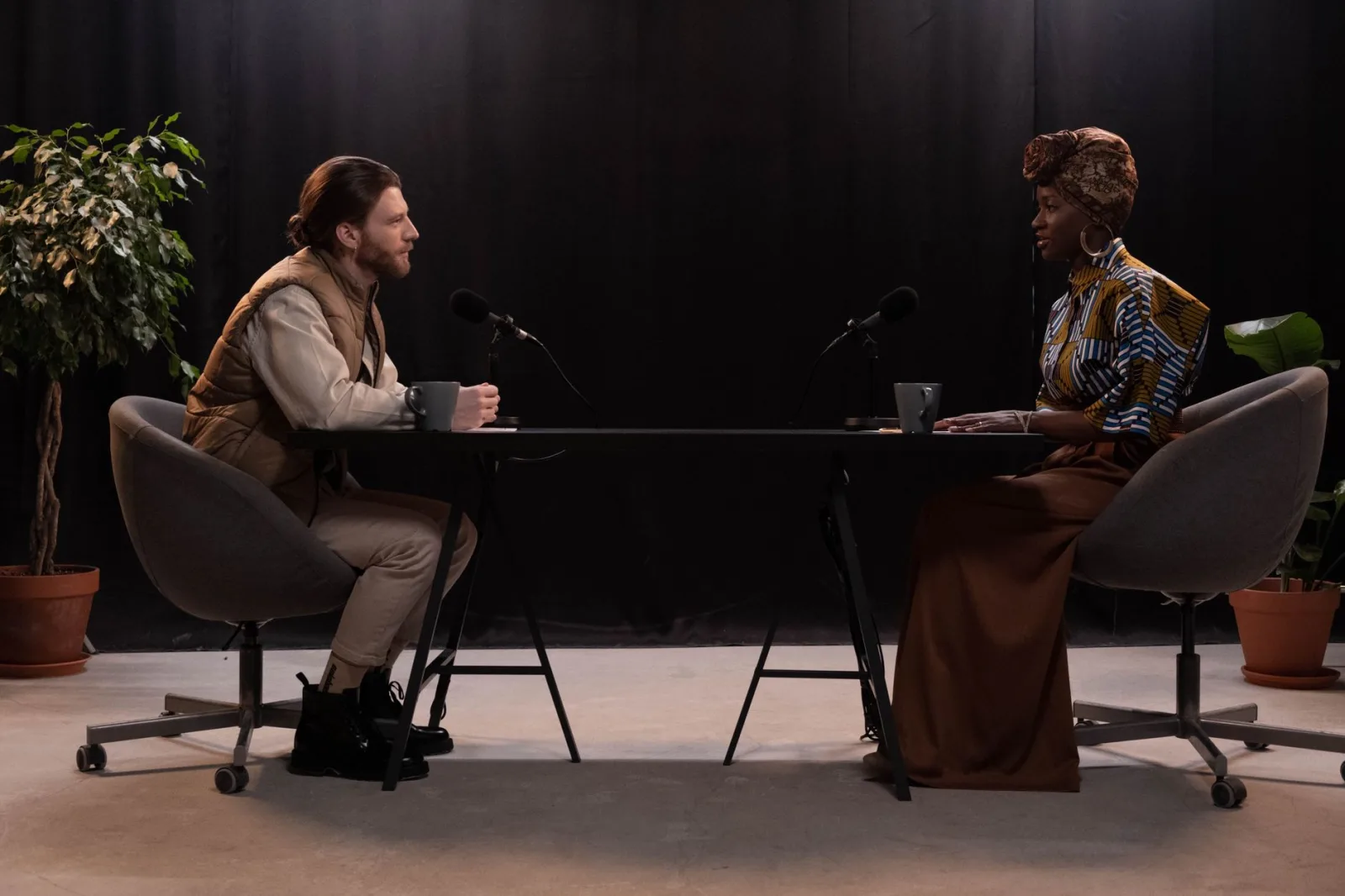
They sat facing each other, he put the camera on a tripod halfway between them, and recorded two hours of good conversation.
In the edit he found the problem: the conversation is two hours, the video has to be twenty minutes, and every cut he wants to make jumps visibly. No second shot, no cutaway, nothing to cover a cut with.
So he ended up with either a video that jumps every minute, or a two-hour video nobody watches.
The problem is not the single camera, it is the cutting
You can film an excellent conversation with one camera. What you cannot do is shorten a long conversation with nothing to cover the cuts.
Any cut within the same shot, the same angle and the same framing shows as a jump, because the person moves between the two moments. So everything in this article serves one purpose: leaving the session with material that can be cut.
Three ways to film a conversation with one camera
The first: a fixed wide shot holding both.
You set one shot containing both people and record the whole conversation.
- The easiest to execute, and you lose none of the conversation.
- And you cut over it with cutaways shot before or after.
- It suits a short conversation, or one where the place itself is part of the story.
Its weakness is looking static if it runs long. So if you use it, make the frame handsome and tidy, because it will be on screen a long time.
The second: two angles in two recordings.
You record the whole conversation from an angle on the first person, then repeat the same questions and record from an angle on the second.
- It gives you material you can cut however you like.
- And it needs a cooperative guest and the energy to repeat.
- It suits prepared interviews rather than spontaneous conversation.
Its condition is keeping the framing, the colour and the audio alike across both recordings, or the cut between angles looks like a move between two places.
The third: the camera at your shoulder.
You sit with your back to the camera or your shoulder in frame, and the guest faces it. So the guest's shot is the main one, and your voice is only heard.
- The strongest in practice for documentary videos and travel interviews.
- It creates a sense of closeness and needs no repetition.
- And it has one weakness: you do not appear, so if your appearance matters, use the first method for part of the conversation.
How to seat the two people
Three points settle the frame:
Do not seat them exactly facing each other. Put an angle of around ninety degrees between them, which lets you place the camera so you see one full face and half of the other.
Keep the eyeline consistent. If you shoot two angles, each person must look in the same direction in all their shots, or in the edit both will seem to be looking the same way. That is the line of action, and its rules are in the line of action and cutting rules.
Leave space in the direction of the gaze. Somebody looking right needs more space on the right of the frame. And the rest of the framing rules are in composition and framing.
Audio matters more than the angle
In a conversation, audio is half the work, and a viewer tolerates a middling picture and will not tolerate unintelligible sound.
And the best simple answer: a microphone for each person, even a small clip-on. And if you have only one microphone, put it on the guest rather than on yourself, because your words you can redo or narrate over, and theirs cannot be redone.
And if you have one directional microphone, place it halfway between them, angled towards whoever talks most.
And before any of that: the room. A conversation in a room with echo is rescued by no microphone, and the fix is cheaper than you think, in the room comes before the microphone.
The shots that make cutting possible
The most important section here. Before you end the session and pack up, shoot five things, ten seconds each:
- A listening shot of each person: their face while listening, silent, looking at the other. The most useful shot in the whole video.
- A hands shot: the guest's hand on the table, or moving something.
- A wide shot of the place from another angle.
- A detail in the room: a cup, a book, a tool from their work.
- Two minutes of room tone with no talking.
Those five take three minutes, and with them you can shorten a two-hour conversation to twenty minutes without a single jump.
And if you did not shoot them
It happens. And you have three moves in the edit:
- Zoom the frame slightly on one side of the cut, so the cut sits between two different sizes and reads as deliberate.
- On-screen text covering the cut point.
- Continuous audio over the cut: the guest's sentence continues over a different image.
All three are rescues rather than solutions, and the solution is shooting the five shots.
A checklist before the session
Five minutes before the guest sits down:
- Lock focus on their eye and test five seconds.
- Set exposure on their face rather than the window behind them.
- Start recording and test both microphones together.
- Sit in the guest's place and look at the frame yourself.
- Confirm the battery and the card cover twice the expected time.
And the mistake that recurs more than any other: the recording ending in the middle of the best part because the card filled. Always bring a second card.
And during the conversation
- Do not stop recording between questions. Stopping costs you spontaneous moments, and a larger file is cheaper than a lost sentence.
- Stay silent for three seconds after every answer. The best sentences arrive in that gap, and the silence gives you room to cut.
- Look at the guest rather than the screen. If you watch the camera the whole time, so will they.
- If they get something important wrong, ask them to repeat the sentence calmly, and tell them it is normal.
In short
With one camera you choose between a wide shot holding both, two angles in two recordings, or a camera at your shoulder making the guest the main shot. And in every case: a microphone on the guest before one on you, a consistent eyeline, and three minutes at the end shooting the listening, hands and room shots. Those three minutes are the difference between a conversation you can cut and one that stays two hours because nothing covers its cuts.