
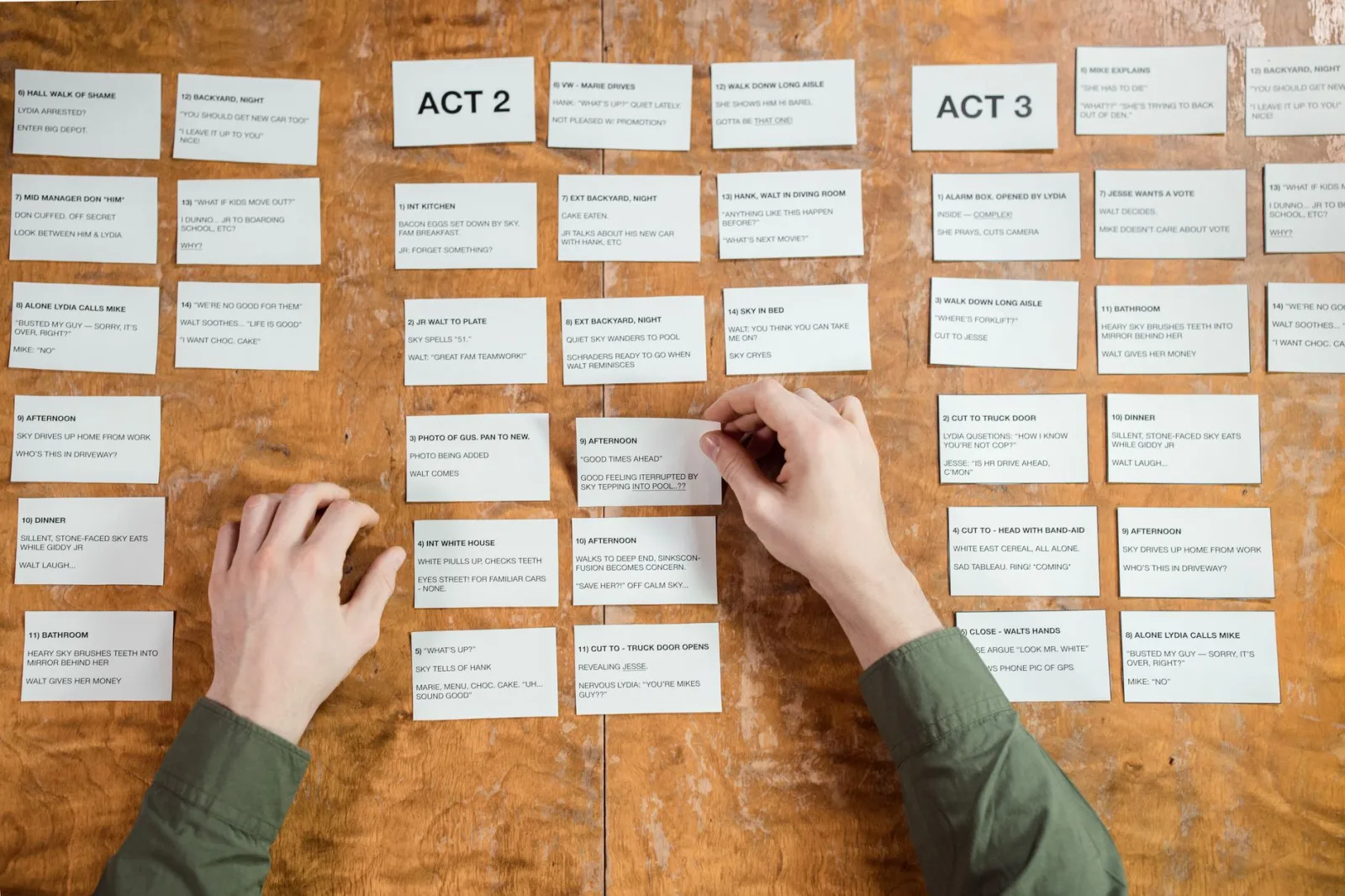
There were eighty ideas in his list and forty videos on his channel. In a review session he read the past year's titles in a row and found something he had not expected: not two titles belonged to the same thing.
Forty good subjects, each one an island. And the viewer who loved one video found nothing to watch next, so they left.
The problem was not the ideas; the ideas were good. The problem was that nobody had arranged them into lines.
Why a series beats a standalone video
Three practical reasons, not one:
1. The second watch. Somebody who liked your video is looking for the next one in that same moment, and a series hands it to them without their searching. The second video is what makes a subscriber, and arranging that on your page is set out in your channel page and playlists.
2. Filming gets cheaper. Episodes of the same series share the location, the lighting, the identity and the opening. You film three in a day instead of three days.
3. Writing gets faster. A series has a template, and a template removes half the decisions in every episode. The most tiring thing about a standalone video is starting from a blank page every time.
A series, a playlist and a season: three different things
A series: independent videos united by one question, published with no fixed end. Such as: "how to make X at the lowest cost."
A playlist: an arrangement made after publishing, which may gather videos never made as a series. An organising tool rather than a planning tool.
A season: a fixed number of episodes with an announced beginning and end. Stronger on commitment and heavier to execute, and it suits you if you can film most of it before publishing the first.
And the common mistake: announcing a ten-episode season and stopping at the third. Start with an open series, and turn it into a season once it has proved itself.
Three ways to group what you have
Open your idea list and read it three times with three different eyes:
1. By the question. What question does this idea answer? You will find that ten scattered ideas answer one question in different forms. That question is your series' name.
2. By the viewer's stage. Arrange your ideas on a line: somebody who has not started, somebody who started yesterday, somebody a year in, somebody doing this for a living. Each stage is a series, and the viewer recognises themselves in it at once.
3. By format. Is there a shape that recurred in your videos and worked? "Fix this with me", or "I tried X for a month", or "before and after". A successful format carries twenty subjects.
And any idea that fits no line, leave standalone. Not everything has to be a series.
Four conditions for a workable series
Before you call it a series, check all four:
- A uniting question in one line. If you cannot say in a line what the series gathers, it is not a series but a collection.
- At least three ready ideas. Ready means you know what you would film. And turning a vague idea into a filmable one is set out in from a vague idea to a filmable one.
- A template that repeats. One structure that fits every episode, rather than a structure you invent each time.
- Value in each episode alone. Somebody who watches the seventh episode first has to benefit without watching the six before it. That condition is the difference between a series that grows and one that locks itself in.
How many episodes?
Start with three. Three is enough for you to know whether the series works, enough for the viewer to feel it is something continuing, and not enough to exhaust you if it fails.
And after the third, look at two numbers: did people stay in those episodes longer than your channel's norm, and did comments arrive asking for the next one. If yes, carry on. If no, stop it with no announcement, because a series that never announced an end needs no announcement of a stop.
Structure: what repeats and what changes
A series' power is that the viewer knows what to expect. So fix four things:
- The name and the title's form. A fixed wording and a fixed place for the number or subject.
- A short opening that says what this series is in one sentence, for whoever arrives at episode five.
- The internal order of sections. The same stops in the same order.
- One visual element in the thumbnail: a colour bar, or a fixed position for the text.
And change one thing in every episode: the subject. Everything else stays, because that is what makes a series recognisable.
The order: which episode first?
Do not start with the hardest or the most general. Start with the episode that answers the question people ask most, because that is what brings an audience to the whole series.
And save your strongest idea for the third episode rather than the first. Because the third decides whether the series survives, and because a first episode is always watched by fewer people.
Publishing: consecutive or spaced out?
Consecutive (every week on the same day) is stronger if you can hold the commitment, because it builds anticipation.
Spaced out (an episode every third video) is safer if your audience is varied, because a consecutive series pushes away anybody the subject does not concern.
And the rule: do not announce a date you cannot protect. An announced date missed twice does more damage than never announcing one.
Titles: connect without scaring off a new visitor
A number at the start of a title frightens somebody who has watched nothing: "episode seven" tells a new visitor they are late.
The answer: let the title stand on its own, and put the series name after it or at the end. Subject first, series second. And whoever wants the order will find it in the description and the playlist.
A series does not end, it stops
You do not need to announce an ending. Stop adding episodes when:
- The ready ideas have run out and only filler is left.
- An episode costs more to make than it returns.
- Your channel's subject has shifted.
And leave the playlist as it is, because a stopped series keeps working for years for whoever arrives at it new.
An hour's session now
Open your idea list, read it once, and ask one question of every idea: what question does this answer? Write the question beside it. Then group the similar questions together.
You will come out of that hour with two or three series that were asleep in your list, and you will not have needed a single new idea. And why lists become graveyards and how they stay alive is the subject of your idea stock: why it becomes a graveyard.