
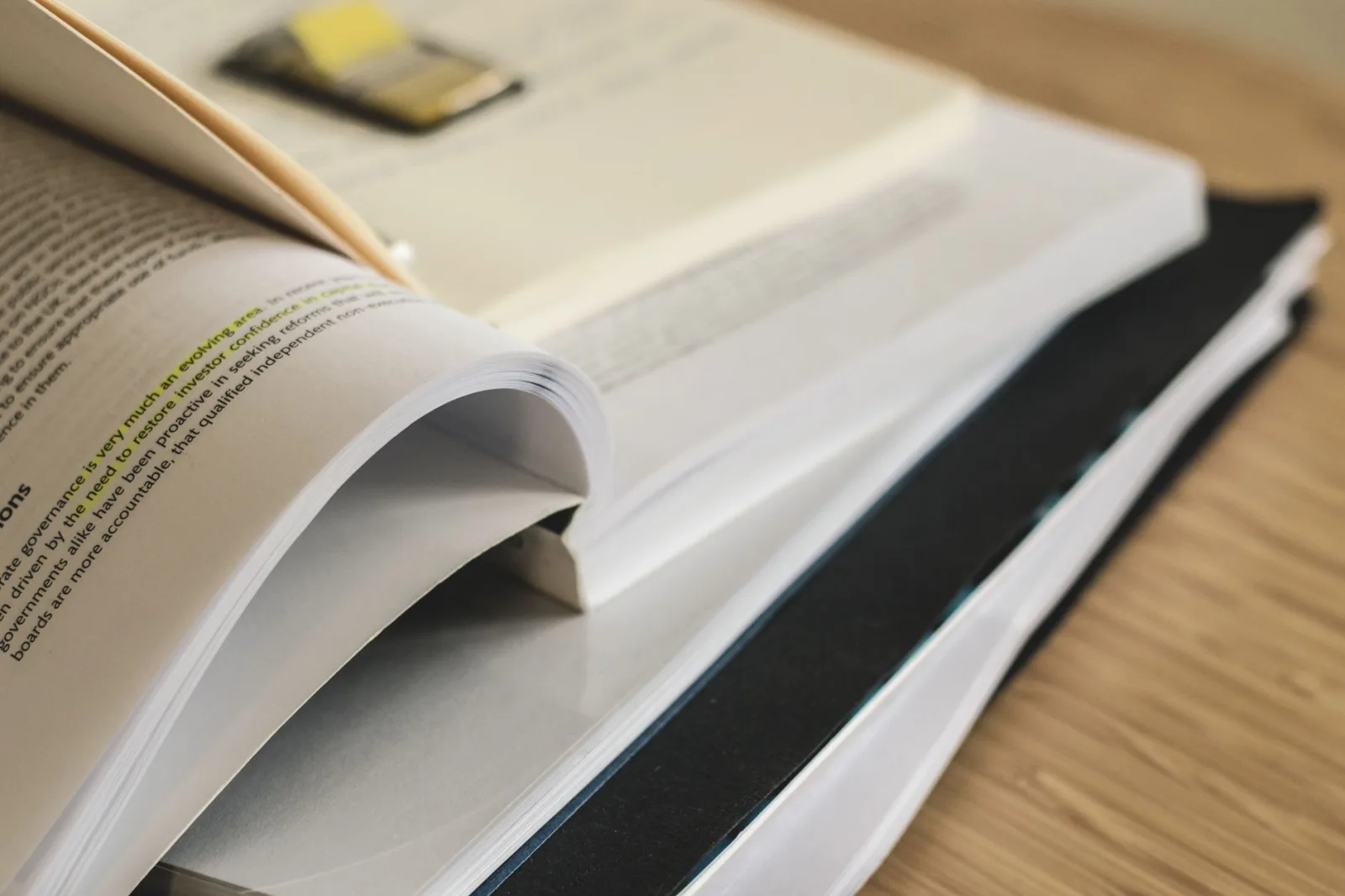
This article is a way of working, not legal advice. Copyright law and the limits of permitted quotation differ enormously from country to country, and every publisher has its own terms. For commercial work or a long passage, ask a lawyer or the publisher itself.
He made a video about a book he liked. In the fourth minute he read two pages of it in his own voice over quiet footage, because the writing was beautiful and he did not want to spoil it by paraphrasing.
Two weeks later a message arrived from the publisher asking him to remove that section.
That same week a different comment arrived under another video: "this analysis is so-and-so's argument from his article, and you did not mention him."
Two different matters had got mixed up for him: a legal right in a protected text, and professional attribution for an idea that is not his. The first may cost you a video; the second costs you trust, and the second is dearer.
The first rule: the wording is what is protected
Copyright protects the form in which an idea was written, not the idea itself and not the information.
Which means in practice:
- You may say what the book says in your own words. Explain the writer's idea, set out his argument, and discuss it. And you name him because that is professional manners, not only because the law may require it.
- You may not carry over his wording. Reading a page verbatim is reproducing the work rather than quoting from it.
- A bare fact belongs to nobody. A date, a figure, an event. But verifying it is your duty, and how to do that is in Research Before Writing: How to Gather Your Material and Verify It.
Four questions that settle any text quotation
- How much of the work did you take? Two sentences from a three-hundred-page book is one thing; a page from a two-page article is something else entirely. The proportion matters more than the absolute length.
- Are you discussing it or presenting it? A quotation that arrives to be built on stands far stronger than one left standing alone.
- Did you take the heart of the work? The central idea the book is bought for.
- Does your video make the original unnecessary? If somebody watching you does not need to read the article, you have taken its place.
These are the same questions that govern visual quotation, as in Quoting somebody else's content and reaction videos: where are the limits?.
Table: by kind of text
| Kind of text | The practical limit |
|---|---|
| A recent book | A sentence or two with the name and title, and your commentary longer than the quote |
| A news article or a blog post | A short phrase and a link in the description, not the whole paragraph |
| A research paper | The finding in your own words with the researcher's name and the year, not the abstract copied |
| Poetry or song lyrics | The narrowest door: ask permission or do not quote |
| An old public-domain text | Available, with care about the edition, the scholarly editing and the translation |
| Any translation | A protected work in itself, needing a second permission |
Poetry and lyrics: the narrowest door
A short poem is a complete work in a few lines. So two lines of it are not a small quotation; they may be most of the work. And song lyrics have bodies that administer their rights and monitor use closely.
The three alternatives: ask the poet or the publisher for permission, describe the meaning in your own words and name the line as a title without reciting it, or use a text old enough to be out of protection. And even then, a modern edited edition and a translation carry rights of their own.
Translation is a separate matter
A point many Arabic creators overlook: if you quote a foreign book from a published Arabic translation, you are quoting two works: the original and the translation. The translator holds a right in their wording.
And if you translate the passage yourself, you are making a derivative of a protected work, which does not make it yours.
The safer method: give the meaning in your own words, saying "he says in his book that..." without carrying over the translated phrasing verbatim.
Text on screen
Showing a photograph of a book page or a screenshot of an article is reproducing the work as it stands. It is safer to set the short quotation in your own type and layout, with the author's name and the title beneath it.
A book cover is another case: a cover is an artwork with a designer, and safe image sources are in Photos and Archive Footage: Where to Source Them Safely.
How to attribute in a video
Three layers, and no single one of them is enough on its own:
- In your voice: "Hassan says in his book about cities, published in such a year...".
- On screen: a small line with the name and the title while the quotation runs.
- In the description: the full source, with a link where one exists.
And "sources in the description" alone is not enough for a figure or a fact you build your argument on, because most viewers never open the description, and presenting figures in a video has its own rules in Numbers and facts in a script.
A permission request in four lines
"Hello, I am [your name] from the channel [name and link]. I am making a video about [the subject], and I would like to read or show a quotation from [the book and page], around forty words, crediting the author and the title on screen and in the description. Do you agree?"
Send it to the publisher rather than the author if the book is recent, since the rights usually sit with the publisher. And keep the reply.
A working method that prevents the problem
- A sources sheet beside the script. Every fact with the work's name and the page.
- Always write the first draft in your own words. Anyone who starts by copying the text finds it hard to get free of it.
- Mark every carried-over line in quotation marks in the script. So you know before filming how much of your video is not your words.
- Read the script asking: what did I add? If the answer is "I arranged somebody else's argument", the video needs an angle rather than more sources.
And if a complaint arrives
Do not argue and do not ignore it. Read exactly what is being asked: remove a section, add attribution, or take the video down. Most publishers accept an amendment, since an amendment is cheaper for them than a dispute.
Whatever arrives automatically from the platform itself follows a different path, set out in You Got a Strike or Your Video Was Removed: Now What?.
In one line
Take the meaning and give the name. Whoever tells what he read in his own words and names who he read builds a reputation; whoever reads other people's pages over quiet footage builds a video that is not his.