
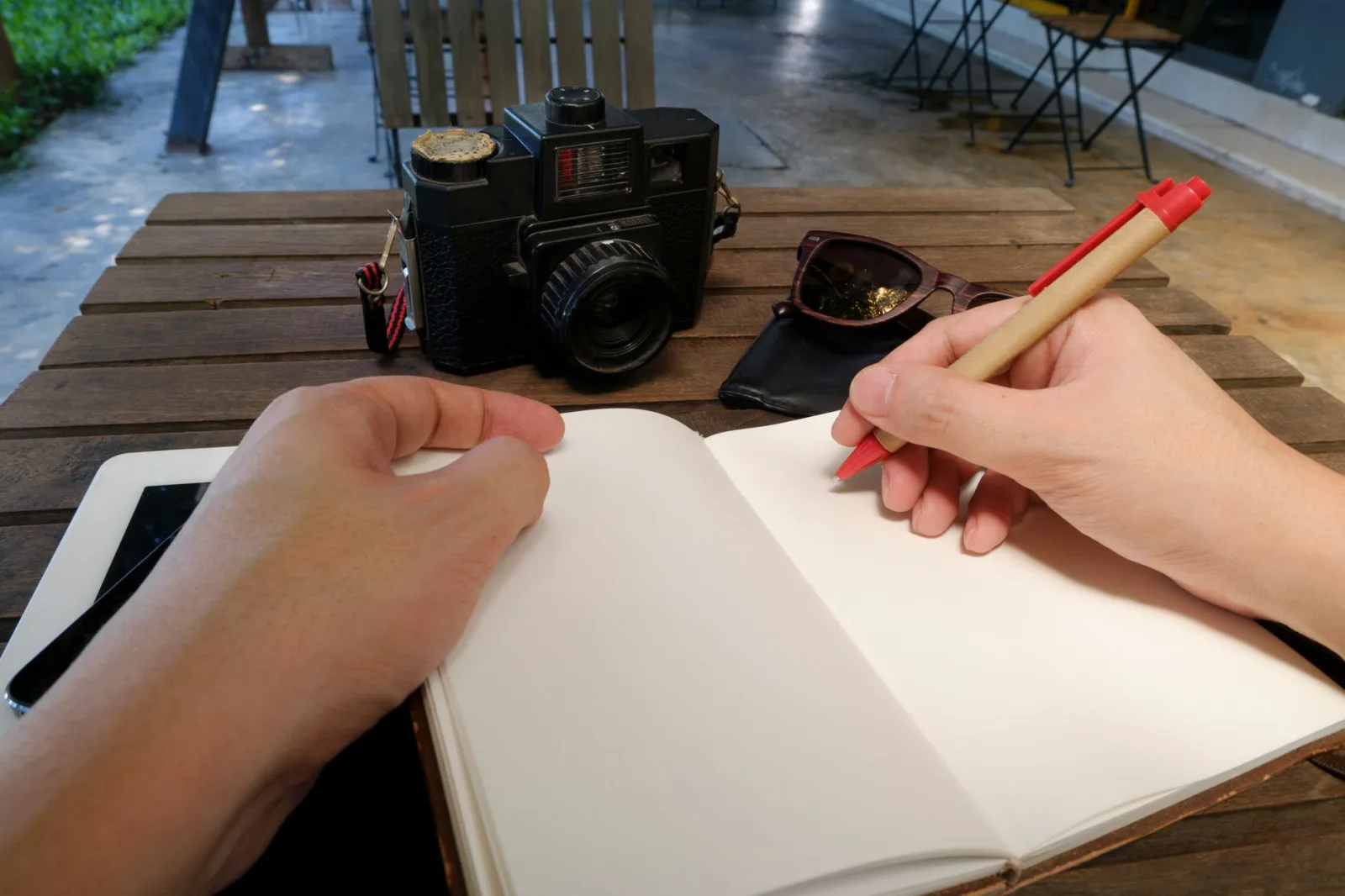
He came back from three days of filming with better material than he expected: a morning in the market, a man explaining his craft, and a woman talking about a custom he had never heard of.
Two months later he sat down to edit. And found that he could not remember the man's name, did not know how the lane's name is correctly spelled, and could not recall the sentence the woman said, which was the best thing in the whole day, because she said it before he switched the camera on.
The material is there and the context is gone. That is what the absence of a field notebook does: it does not lose you the footage, it loses you the ability to assemble it.
Why a phone is not enough on location
Not because paper is nobler, but for practical reasons: the battery you need for the camera, your hands being full, the rain, and the fact that you are mid-conversation with somebody and opening your phone makes you look busy with something else.
The arrangement that works: a small notebook in your pocket and a pen that writes at any angle, a voice note to yourself while walking between locations, and transferring both into the file at night.
The six fields you cannot recover
Do not write everything. Write the six that are impossible to recover after a week:
1. Names and how they are spelled. The person's name as he wants to be credited, the place's name, and the name of any local craft or tool. Ask him to write his own name in your notebook, which settles the spelling question entirely.
2. The place and the time. Where exactly and at what hour. You need this if you return to film the same light, and you need it in the edit to order the day.
3. Sentences word for word. What people said before you switched the camera on or after you switched it off. These are the most valuable lines in the notebook, because the best thing anybody says is usually said outside filming time. Write it in quotation marks as heard, not in your own style.
4. The consent status. Who agreed, to what, and what they asked not to be published. One line that protects you from a problem that cannot be fixed after publishing.
5. The missing shot. Every time you think "it would have been good to film that", write it in one column. That column is the next day's shot list, and it is what prevents the problem in How to Build a Film From Footage You Shot Without a Script.
6. What surprised you. This is the most important and the most neglected.
The surprise column
On your first day in a new place, everything catches your eye: the way people talk, the shape of the doors, a man carrying something odd. By the fourth day nothing catches your eye, because you have got used to it.
The film's angle lives in the first day's notes. So write your raw reaction with no polish: "strange that they do this", "I did not understand why", "this resembles such and such back home".
Read that column after the trip. You will find three questions in it you never answered, and one of them is the film.
The day's page: a ready template
One page per filming day, split by a line down the middle:
| Top of the page | The date, the place, the weather and the light |
|---|---|
| Right column | Facts: names, times, figures, sentences word for word |
| Left column | Your questions, impressions and what surprised you |
| Bottom of the page | One line: the first thing you do tomorrow |
That bottom line is what lets you start the next day with work rather than thinking. And on a seven-day trip, seven pages are worth half the film, as in the division in The shooting trip schedule: how do you split seven days between research, filming and rest?.
Logging takes in the field
Four small columns at the back of the notebook, with a line for every take worth keeping:
- The card number.
- The time on the camera, to the minute.
- A three-word label: "the man laughing", "market at dawn".
- A star if it is the best of three takes.
Those lines are what turn three hours of sifting in the edit into twenty minutes. And across a long archive they become a full index, as in Indexing your footage archive with AI.
A ten-minute ritual at night
Before sleeping, after charging the batteries and copying the cards, sit for ten minutes:
- Transfer the names and the consent status into the project file, since those two items must not depend on a notebook that could be lost.
- Read the missing-shots column and write tomorrow's plan.
- Write one line: what is the film as of tonight? You will find that line changing every night, and its changing is what produces the structure.
Ten tired minutes at night are kinder than three hours of guessing two months later.
The limits of what you write about people
A notebook full of private details about people becomes a liability rather than a tool. So write what serves the work: the name, the role, the consent, and the sentences they allowed you to publish.
Do not write what was told to you in confidence in order to use it, and no household secrets. The rule: if you lost your notebook and the owner of the place found it, would what is in it harm him?
And after the work is finished
Do not throw the notebook away and do not simply shelve it. Do two things:
Extract three ideas. Questions left unanswered or lines never used, entered into your idea stock with their detail rather than as a vague line. The rules for what stays alive are in Your Idea Stock: Why It Becomes a Graveyard and How to Keep It Alive.
Keep the sources with the project. The figures and names you wrote need verifying before they are said in the video, and how to do that is in Research Before Writing: How to Gather Your Material and Verify It.
And the difference you notice
Whoever writes on location comes back with material that can be assembled; whoever does not comes back with beautiful material he needs to remember. And memory after two months keeps neither names nor sentences; it keeps one thing: the general feeling. And a general feeling does not make a film.