
He wrote a good script, a thousand tidy words, and decided to memorise it so his delivery would be exact.
He sat in front of the camera. On the first take he forgot the third sentence, on the second he said the fourth paragraph before the third, on the seventh he lost the last word. By take seventeen the words came out perfectly, with no mistakes.
And in the edit he opened the file and found something odd: the words were right and the face was dead. His eyes were looking somewhere far away, his voice sounded like a pupil reciting a lesson, and all the enthusiasm that had been in the script had drained away across the takes.
The method was wrong, not the script.
Three methods, each with a price
| Memorising | Teleprompter | Speaking freely | |
|---|---|---|---|
| Naturalness | low | medium | high |
| Factual accuracy | high | high | medium |
| Preparation time | very long | medium | short |
| Filming time | long (retakes) | short | medium |
| Editing time | short | short | long |
| Suits | short scripts and ad reads | explaining with numbers and order | personal experience and vlogs |
Notice the last two rows: what you save in preparation you pay in the edit, and what you save in filming you pay in preparation. There is no free method, only a choice of where to pay.
Memorising: when it works
It works in one case: a very short piece that has to be word for word. An opening line, a sponsored paragraph, thirty seconds containing precise figures.
Beyond that, memorising eats your naturalness. The reason is simple: your mind is busy retrieving the next word, so there is no room left for expression, for tone, or for looking into the lens as though you meant it.
And if nerves in front of the camera are what push you towards memorising, the problem is elsewhere, and its cure is in how to speak to a camera without freezing up.
The teleprompter: six rules that keep you from looking like a reader
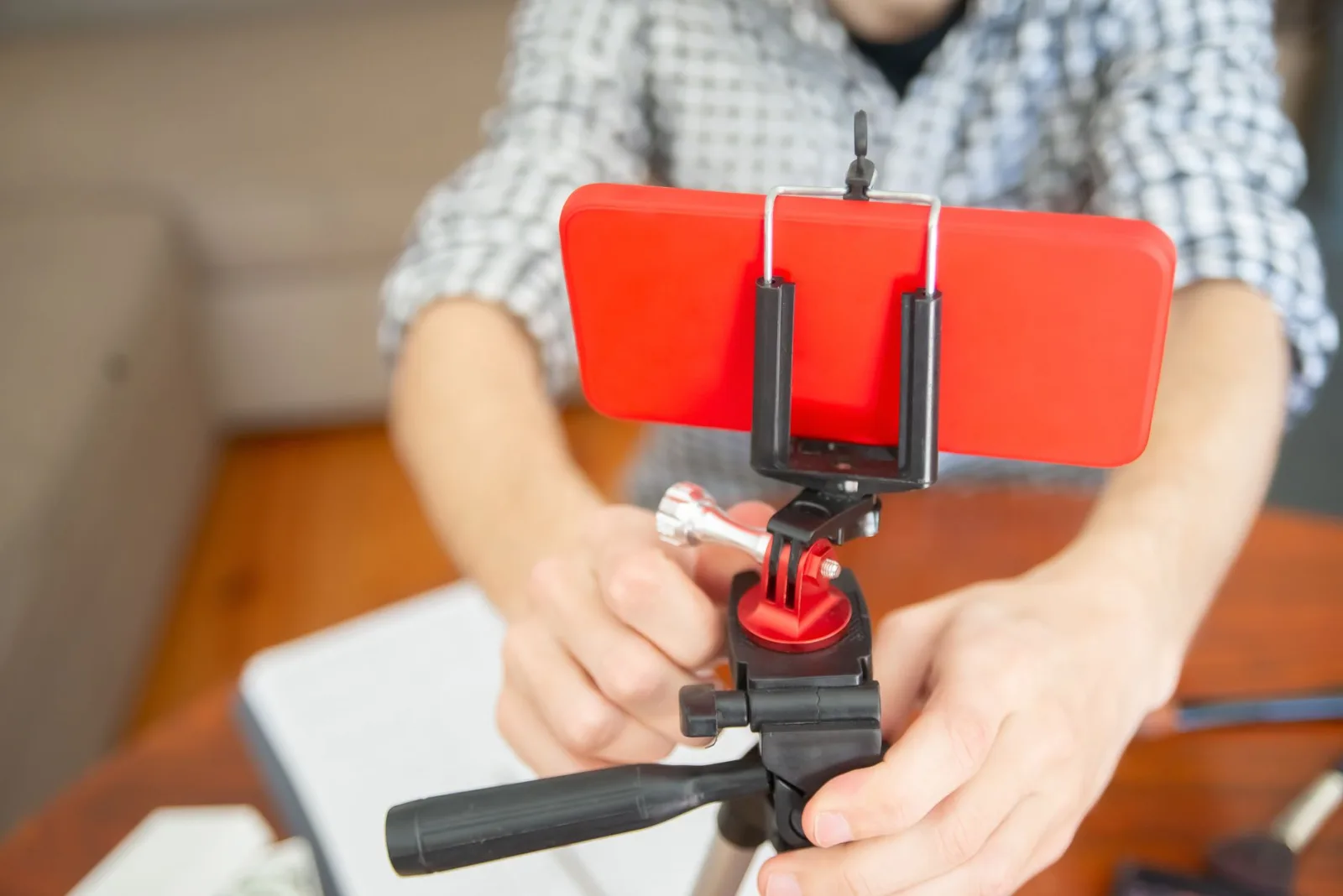
A prompter is an excellent tool that most people misuse. It does not have to be a mirror rig; an app on a phone or tablet will do.
1. Put the text right at the lens. The most important thing. If the text sits beside or below the camera, your eyes will visibly be looking at something else. Best is a mount that puts the phone in front of or very close above the lens.
2. Stand a little further back. More distance makes your eye movement between line and lens unnoticeable. Very close up, you are exposed.
3. Keep the line very short. Five or six words per line. A long line forces your eye to travel sideways, and that movement is what makes a viewer say: he is reading.
4. A slower speed than you think. Most people set it fast and end up panting. Set it so that you are slightly ahead of the text rather than chasing it.
5. Write for the ear, not the eye. A sentence written to be read feels heavy when spoken. Read your script out loud before filming, cut everything you stumble on, and swap long constructions for the way you would say it to a friend.
6. Stop and cut. Do not film ten continuous minutes. Film one idea, stop, then join them in the edit. That reduces mistakes and improves the rhythm.
The prompter's great benefit is how much it shortens the shoot day, which is why it is used by anyone filming several videos in one sitting, a method we covered in how to film a whole week's content in one day.
Speaking freely: how to keep it from wandering
Speaking freely is the most natural and honest method, and the most dangerous to your time: anyone talking with no plan films forty minutes to keep five, then spends hours in the edit.
The fix is to have a structure rather than a text:
Five points in front of you on a large sheet. Words, not sentences: "the problem", "the example", "the number", "the objection", "the conclusion".
Memorise two sentences only: the opening and the closing. Those two settle the start and the end of the video, so do not leave them to the moment.
Say the idea once, then stop. What lengthens free speech most is explaining the same idea three times in different words, because it feels as though it did not land.
Film one idea as one short take. Then stop. Separate takes cut easily; a long continuous ramble is either kept whole or dropped whole.
That is the same approach a vlog is written with, where nothing is memorised and everything is written as questions and stops, which we set out in the vlog script.
A fourth method: audio first
An option many people overlook: record the voiceover first, sitting comfortably and reading your script, then film the footage over it.
Three benefits: your delivery comes out clean without camera nerves, you know exactly which shots you need, and you do not have to appear on camera every second. It suits teaching and documentary videos more than opinion and personal talk.
What regular publishers actually use
The mixed method, three layers in one video:
Opening and closing: memorised word for word.
Sections with numbers, order and names: prompter.
Experience, impressions and stories: free, with no page in front of you.
That split gives accuracy where accuracy belongs, and life where life belongs.
Try this week
Take one idea lasting a minute and film it three times: once memorised, once with a prompter, once freely from three points.
Then watch all three a day later, and do not ask which is most correct. Ask: in which one do you look like yourself? That answer is your method, not whatever anybody else uses.