
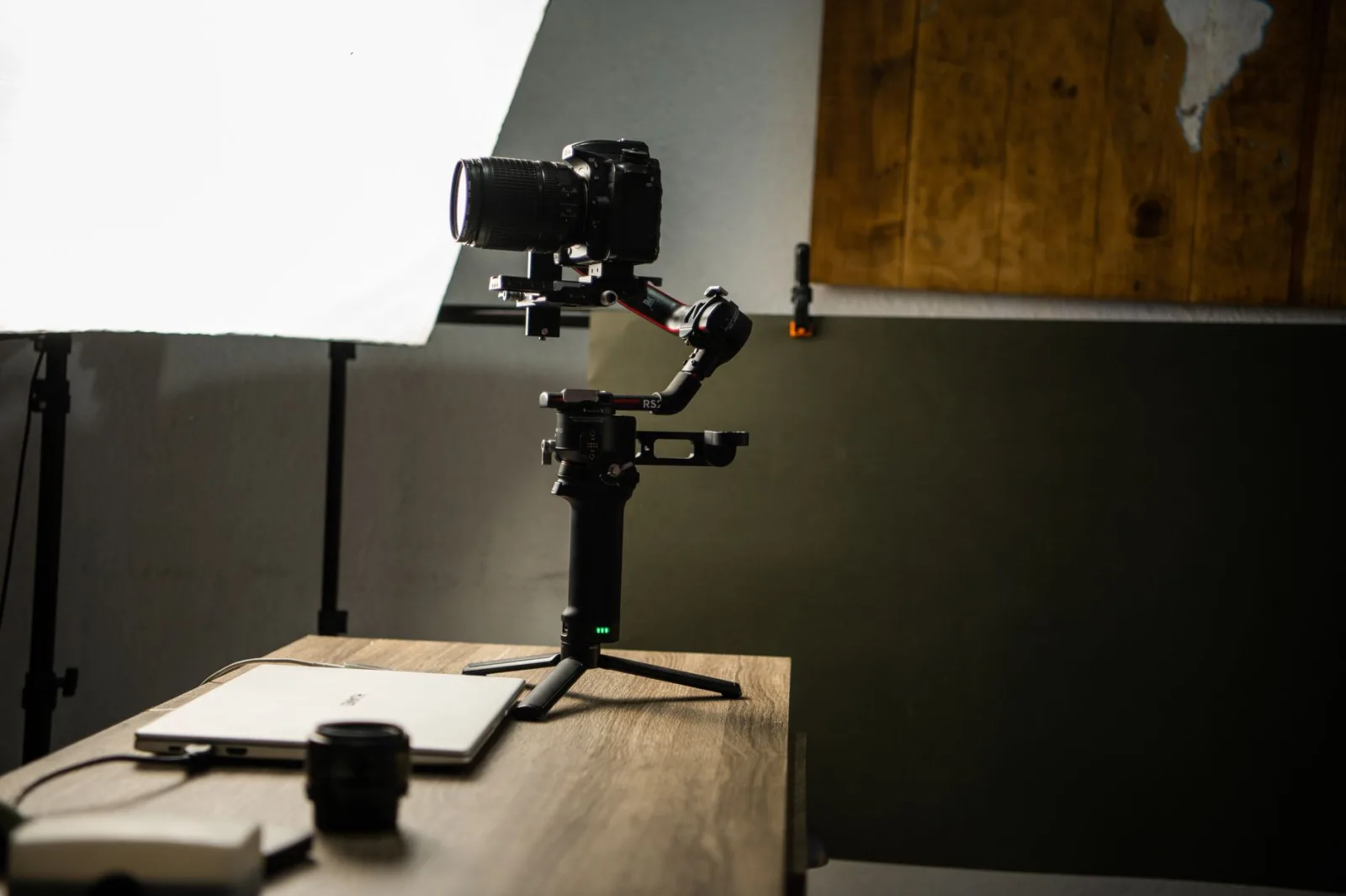
The first piece of gear he bought after the camera was a gimbal. The reason was that he kept seeing smooth moving shots in videos he liked, so he assumed that was the next step.
He used it on one video, then on half of a second, and then it stayed in the bag. It needs rebalancing every time he changes a lens, it needs a charged battery, and it needs a free hand while he is filming alone.
The thing he has used on every video since that day: a cheap little tripod he bought two months later.
Three different things, three different problems
Before any buying decision, separate the three, because each solves a problem the others do not.
A tripod solves one problem: keeping the camera completely still in its place. It serves you for talking to camera, interviews, wide shots, filming in low light, and anything you film while you are not behind the camera.
A mechanical stabiliser or gimbal solves another: making motion smooth while you walk or turn. It does not help a static shot, does not fix an out-of-focus picture, and does not make up for bad lighting.
Software stabilisation, in camera or in the edit, rescues mild shake and crops the edges of the picture slightly. A salvage tool rather than a filming tool.
Most buying regret comes from somebody buying the tool for the second problem while suffering from the first.
Start from one question
Open your last three videos and count the shots: how many are static, and how many are you walking?
If most of your work is static shots with you appearing in them, the tripod comes first by a wide margin. And that is the situation of most creators: explaining, reviewing, or talking to camera.
And if your work is walking and moving, as in a vlog, a trip, or a tour of a place, a gimbal is worth considering after you have exhausted the free moves two sections below.
Tripods: what actually matters
A tripod's price says nothing about its quality. What does:
The head. This is the most important part and nobody looks at it. A cheap head lets the camera creep downward after you have locked it, so you discover in the edit that the frame has drifted. Test this in the shop: mount the camera, point it at an angle, leave it a minute, and see whether it moved.
The weight it carries. Look at the weight of your camera with your heaviest lens, and buy a tripod rated well above that. A tripod carrying your weight at its limit shakes at every touch.
How fast it opens and closes. A tripod that takes a minute to set up is one you will not carry. And that is a real practical reason why some expensive tripods stay at home.
The base. Three legs that spread at a reasonable angle are steadier than three legs standing close together, especially outdoors and in wind.
The small tripod: the most useful purchase for the least money
The small tripod that sits on a table, or the one with flexible legs that wrap around something, is the tool you will use most and the cheapest thing you will buy.
It works for talking to camera at a desk, for detail shots, for voiceover, and for being a brace for your hand while you film yourself. Carry it always, because it takes no space.
A gimbal: what it costs you before it helps
A gimbal is not something you buy and switch on. It has four costs you should know before buying.
Balancing. Every time you change a lens or add a microphone you rebalance it, and that takes time on location.
The battery. A second battery waiting to be charged, and one more thing to forget.
Practice. A gimbal does not create good movement on its own. Walking correctly, turning from the hips rather than the shoulders, starting and stopping smoothly: that is a skill that needs practice, and without practice you get smooth motion that means nothing.
Carrying it. If you film alone while travelling, a gimbal is a large item in your bag, and you may prefer that space for batteries or water.
Four moves that need no gear
Before you buy, exhaust these, because many of the shots you admire are made with them.
- Movement from the body, not the hand. Hold the camera with both hands close to your chest, keep your elbows pressed to your body, and walk in short steps from the knee. That turns your body into a stabiliser.
- Bracing. A wall, a post, the back of a chair, even your own torso while seated. Any third point of contact halves the shake.
- Moving the subject instead. Rather than walking with the camera, let the subject move. Have people pass in front of a fixed camera and you get motion inside a still frame.
- A wider lens. Shake shows more in longer lenses. A wider lens hides a great deal of it.
And which movement serves a scene, and when the camera should move at all, has its own article in filming basics.
Stabilising in the edit: what works and what breaks
Software stabilisation works when the shake is mild and regular. It has two prices: it crops the edges of the picture, and it can create an odd warping in straight lines if the shake is strong.
The practical rule: try it at the lowest setting first, and if you need a higher setting the shot does not work and you should look for an alternative.
The buying order that suits most people
- A small desk tripod, which is a simple purchase.
- A microphone, because sound raises the sense of quality more than anything.
- A full tripod with a good head.
- One light.
- A gimbal, if most of your work really is movement.
And three conditions to apply before any purchase, with an upgrade order across years, are set out in how do you budget a video and decide what to buy and when.
What is not worth your money at the start
- A gimbal before you own a tripod.
- A heavy professional tripod while you film in one room.
- A camera arm or a slider, which are tools for specific jobs rather than for a channel that has just started.
- A very cheap tripod with a plastic head, which is a purchase you make twice.
And if you film on a phone, most of this applies to you with smaller mounts, and the phone's limits and what genuinely works on it are in can you create content with just a phone.
Test before you buy
Borrow a gimbal from a friend or rent one for a day, and shoot a complete video with it. That day tells you what no review will: whether you will actually use it, or whether you like the idea of it.
And if you are at the very start and do not know what to buy at all, the order before all of this is in what do you actually need to start and what you don't.
In short
A tripod is bought because most of your shots are static; a gimbal is bought because most of your shots move. Look at your own videos rather than other people's, and buy for the problem you actually have. And the piece of gear you will thank yourself for is not the most expensive one, but the one that leaves the house with you every time.