
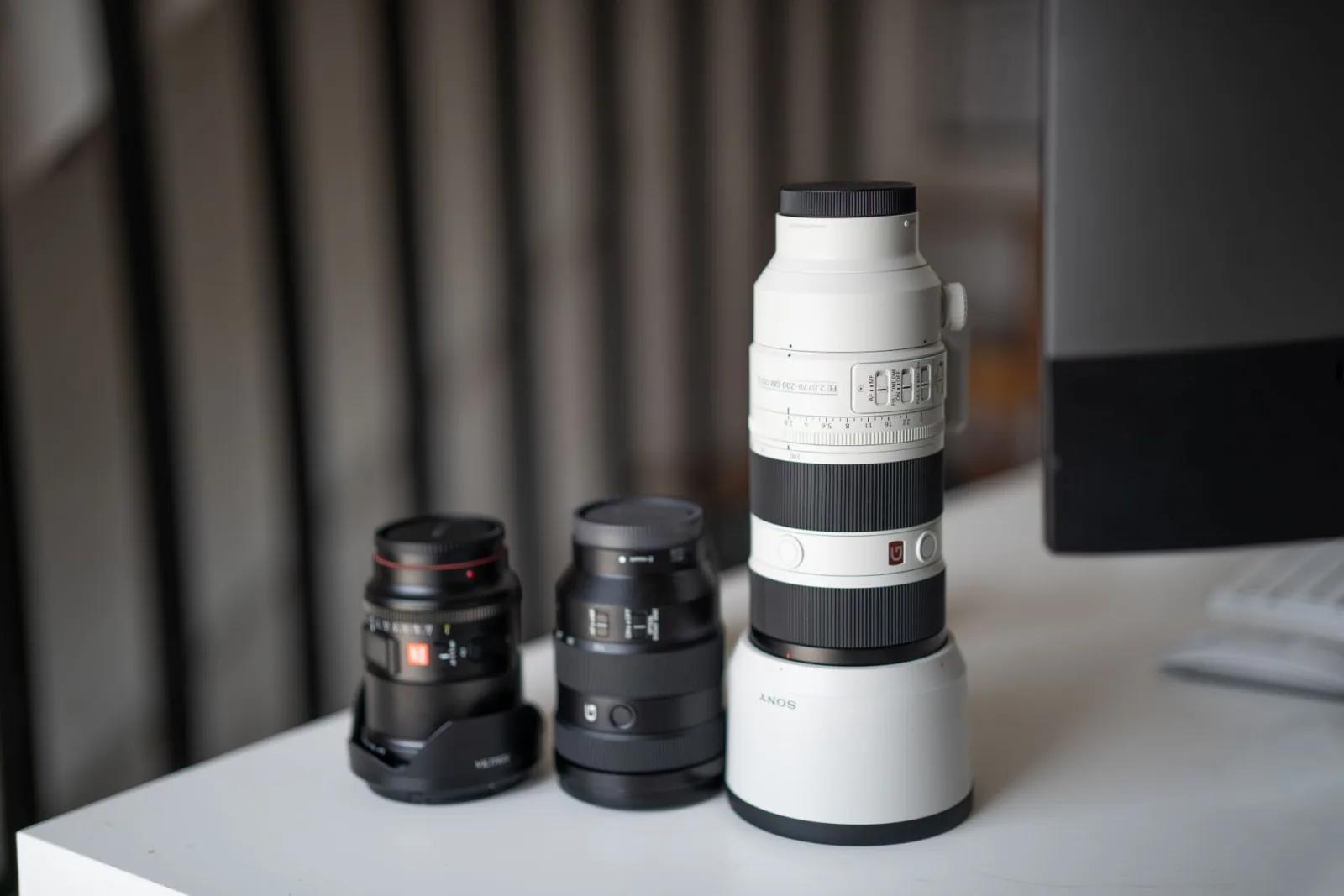
He bought a camera, and a kit lens came with it. Then he read on the forums that professionals use primes, so he bought one, then a second, then a third.
On his first trip he carried all three in the bag. He stood in front of a man working copper, wanted a wide shot of the workshop, and the lens on the camera was too tight. So he crouched on the floor, opened the bag, changed the lens, raised the camera, and found the man had finished what he was doing.
He did not lose a shot. He lost a moment that will not come round again, and he paid for it with three lenses.
Focal length does more than bring things closer
We read the number on a lens (18, 35, 50, 85) as how much it magnifies. That is the smallest thing it does.
The number decides four things inside the shot:
How much of the place is in frame. A wide lens brings the whole room in; a long one isolates the person from their surroundings. If you are filming a market and want the viewer to feel the crowd, the place is part of the story.
Where you stand. Nobody mentions this. To get the same framing on an 85, you back up several metres; on a 24 you get close enough to almost touch. In a small workshop or a car the long option does not exist, so the space decides, not your preference.
The shape of a face. A wide lens up close enlarges the nose and bends the features. A longer lens flattens them and makes them comfortable to look at. That is why interviews are shot longer.
How thick the depth is. A background that melts into soft haze is mostly the length of the lens and your closeness to the person, not the aperture number on its own.
All of this meets the exposure triangle, so if the camera numbers are not clear to you yet, start from the camera terminology and exposure triangle guide.
Three numbers are enough
The numbers below are full-frame equivalents. If your camera has a smaller sensor (APS-C), multiply the number printed on the lens by 1.5 to know what you are really seeing: an 18 on it gives you something like a 27.
24: the place. Wide, it brings in the room, the market, the mountain. Close to a face it distorts the features, so use it for places rather than people.
35: the one lens. The closest thing to what the eye sees, and it handles talking to camera and the room at the same time. If you were to buy one lens for the rest of your life, this is it.
50: the person. It separates the person from the background, flatters a face, and needs room behind you. Excellent for interviews and for close shots on hands and objects.
Everything past that is detail: 16 for anyone filming inside very tight spaces, 85 for interviews in a studio with distance in it.
Prime or zoom?
The question is not about quality, it is about the nature of your work.
A prime (one focal length) is smaller, lighter and cheaper at the same quality, passes more light, and forces you to move on your feet, which improves your framing quickly.
A zoom gives you several focal lengths with no lens change. In documentary work, alone, that is not a luxury: the scene passes once.
The practical rule: if you film arranged scenes you can repeat as you like (talking to camera, cooking, explaining), a prime is better. If you film life walking past you, one wide zoom covering 24 to 70 serves you better than three lenses in a bag.
Which lens to buy first
Choose by what you film, not by what somebody else films:
- Talking to camera in a small room: something near 24 or 35. The room will not allow more.
- Travel and documentary, on your own: one wide zoom, with a small prime alongside it for dim places.
- Interviews: a 50 for one person, an 85 if the distance allows.
- Hands at work and detail: a lens that focuses close; most modern 35s and 50s get close enough.
And if you have the kit lens (18-55), do not replace it in the first month. Shoot with it, fix it at one focal length for a whole week, and you will find out for yourself which length keeps calling you.
f/1.8 is not always the best choice
A wide aperture lets in more light and melts the background. In video it cuts both ways: depth of field becomes very thin, so a person who steps forward goes soft, and if you are filming yourself alone you will only notice in the edit.
Filming solo, shoot at f/2.8 or f/4 and sleep well. A hazy background means nothing if the face is not sharp.
What matters in video more than lens sharpness
Three things get forgotten in comparisons:
Autofocus. In video, a lens whose focus sticks to a face is worth more than a sharper lens whose focus wobbles.
Focus breathing. Some lenses shift their framing slightly as focus changes, which shows up badly in static shots.
Weight. A heavy lens makes you film less. The best lens is the one you actually carry.
And if you film on a phone
Your phone has more than one camera, each at a fixed focal length: very wide, normal, and on some devices a longer one. Those are your lenses. Use the button that switches between them rather than pinching to zoom, because pinching crops the image and throws away detail.
What will improve your picture most is not an extra lens but the light and where you stand, which we covered in where to put your subject in the frame. And for a phone's real limits, can you create content with just a phone has the upgrade order that starts with audio, not the picture.
One week settles the choice
Stop reading comparisons. Do this instead.
Take the lens you have, fix it at one focal length (35, say), and film everything with it for a week without changing. Write on a piece of paper every time you said "I needed wider" or "I needed closer".
By the end of the week the paper will have answered the question for you. The second lens is bought to fill a gap you wrote down yourself, not one you read about.