
The Shot You Lost Without Knowing It
Imagine you travelled a full day to reach a place you'd wanted to film for years. You stood at the edge of the sea, the light was at its best hour, and the man you came for sat down in front of you and told you a story you'll never get twice.
You got home, opened the file, and pressed play.
And you heard a roar. A heavy roar sitting on top of every word the man said, as if someone had held a fan in front of the mic for the whole interview.
You tried everything in the software. You rolled off the low frequencies, ran the noise-reduction tool, pushed the level up and pulled it back down. Every time the roar got a little quieter and took a piece of the man's voice with it, until the speech came out muffled, strange, and unusable.
That moment is the hardest lesson in location sound, and nobody learns it until they've paid for it.
The Rule That Governs Everything Below
Bad audio can't be fixed. It gets softened a little, and then it stays bad.
Look at how the picture treats you. It's dark, you lift it. The colours are off, you correct them. The frame is loose, you crop it. Picture forgives a lot.
Sound forgives nothing. Ruined audio stays ruined, no matter how many panels you open.
So every minute you spend on sound before you press record is worth an hour in the edit. And often it's worth an entire scene you'd otherwise never be able to use.
Wind, the First Enemy
The first thing to understand about wind: it isn't a loud sound you can turn down.
Wind is air physically striking the microphone's diaphragm. The mic doesn't hear the wind, it gets hit by it. That's why lowering the level does nothing, and why no filter removes it afterwards. Anything strong enough to remove it takes your voice along, exactly as in the story above.
The fix happens before you record, in three ordered layers.
The first layer is the black foam that came in the box with the mic. It's enough for a faint draught indoors and nothing else. Never rely on it outside.
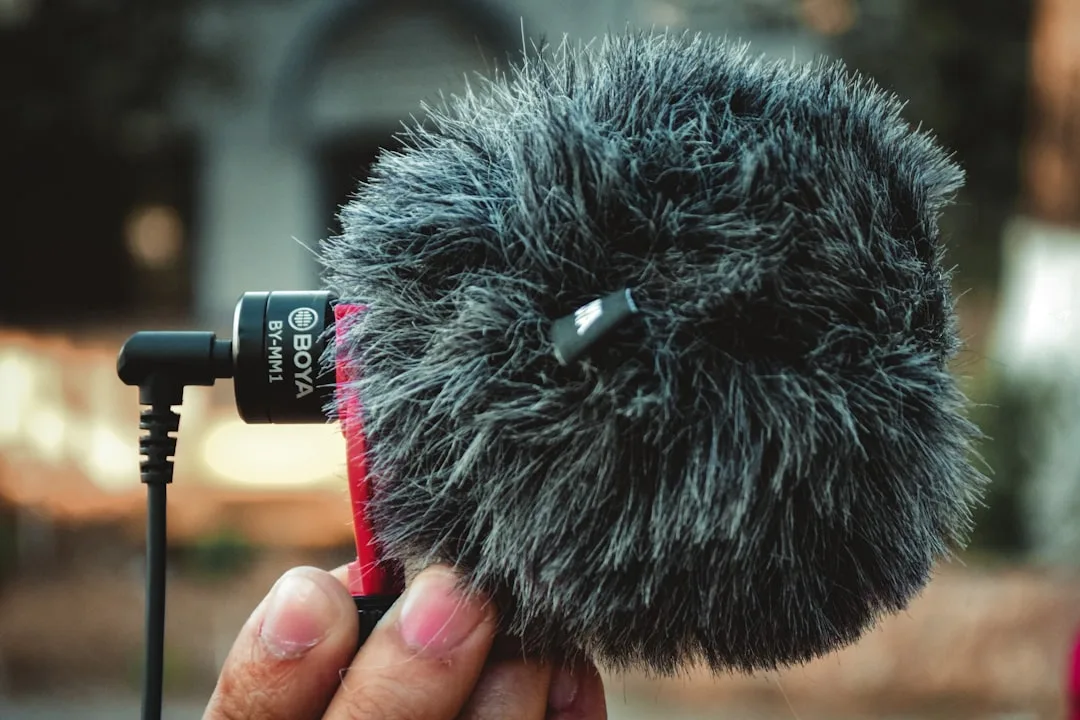
The second layer is the furry cover, the one that looks like the coat of a small animal. This is the real solution. It's cheap, it goes on in a second, and it makes a difference nobody believes until they try it. New rule for you: don't go out to film without one.
The third layer is your own body. Turn your back to the wind and put the person you're filming in your shelter. A wall, a car, even a bag held up by a friend. Any barrier that breaks the airflow does what hundreds of dollars of gear won't.
And before you shoot the real thing, do something that takes half a minute: record ten seconds and listen to them in your headphones. If you hear a low rumble, move now. Don't tell yourself you'll fix it in the edit, because you now know that sentence isn't true.
Noise: What's Welcome and What Isn't
Not every background sound is a problem. Market noise in a market scene serves the film and makes it real. Waves in a beach scene are half the beauty of the scene.
What separates useful sound from noise comes down to two questions.
First: does it cover the speech? If you have to concentrate to catch a sentence, it's noise, however lovely it is.
Second, and this is the one people forget: does it change between shots? A plane that passes in one take and not in the next makes the cut between them audible. The viewer will sense that something odd happened, won't know what, and will step out of the film for a second.
The fix for the second problem is simple and free. Before you pack up and leave, ask everyone to go quiet and record one full minute of the place on its own. No talking, no movement.
That minute gets laid under the scenes in the edit, creating a single sonic floor that hides every abrupt change. It's the cheapest insurance in the entire production, and half of people skip it because they're in a hurry to leave.
Get the Mic Closer Than You Think
There's one rule that solves most location sound problems: move the mic closer to the mouth.
Distance works against you frighteningly fast. The further the mic sits, the bigger the street's share of the recording, and the smaller the share belonging to the person you came to record.
In practice that means a lav mic on the chest, a palm's width below the chin. It means a boom mic lifted above the frame with its head aimed at the mouth rather than the chest. And it means the camera mic is your last option, because from two metres away it records the location far better than it records the person.
A lav outdoors needs its own small fur cover too. And clip it away from the collar, away from any necklace, away from anything that rubs with every breath.
What You Do While You're Standing There
Listen with headphones, not with the meter. The meter shows you level and nothing else, and it can't tell your voice apart from the hum of an air conditioner. A simple pair of headphones reveals the shirt rubbing, the fan in the next room, and the phone buzzing in somebody's pocket.
Set your level for the loudest sound you expect, not the quiet one. Let the peaks land around minus twelve. Above that you're inviting distortion, and distortion is never repairable.
And record two seconds of silence before the speech and after it. You'll need them in the edit every single time.
Know What Can't Be Fixed Before You Rely on It
| Problem | Fixable? |
|---|---|
| Slightly low level | Yes |
| Light steady hiss | Partly |
| Air conditioner or fan, steady tone | Partly, at a cost to the voice |
| Wind hitting the mic | No |
| Distortion from a hot level | No |
| Echo in an empty room | No |
| Two people talking at once | No |
The last two rows always surprise people. Echo can't be removed because it's mixed into the voice rather than layered on top of it. And two overlapping voices can't be separated by any tool that exists today, so make sure one person speaks at a time, even if it means interrupting and restarting the exchange.
Five Minutes Before You Begin
Put the fur cover on the mic.
Clip or place the mic close, then ask the person to move the way they'll actually move, so you can hear any rubbing.
Record ten seconds and listen to them in headphones.
Set the level for the loudest expected moment, not the quiet one.
Then ask one last question: can I move ten metres away from this road? Usually you can, and those ten metres do more than any piece of gear.
And at the end, before the bag goes on your back: one minute of the place.
In Short
A fur cover on the mic, the mic kept close, headphones in your ear, and a minute of room tone before you leave.
Whatever you can't fix standing on location, you won't fix anywhere else on earth. So change your position, or wait for the lorry to pass, or come back at a quieter hour.
The man who told you his story at the edge of the sea deserves five minutes of your time before you press record.