
He decided to film in the bedroom because it was the only quiet room in the house. He put the camera on the tripod as far back as it would go, which left a metre between him and it, so he used the wide lens, the only one that fitted his whole face in.
On the computer the result was: his nose larger than it is, the wall right against his head and brightly lit, and his voice carrying an echo as if he were in a corridor.
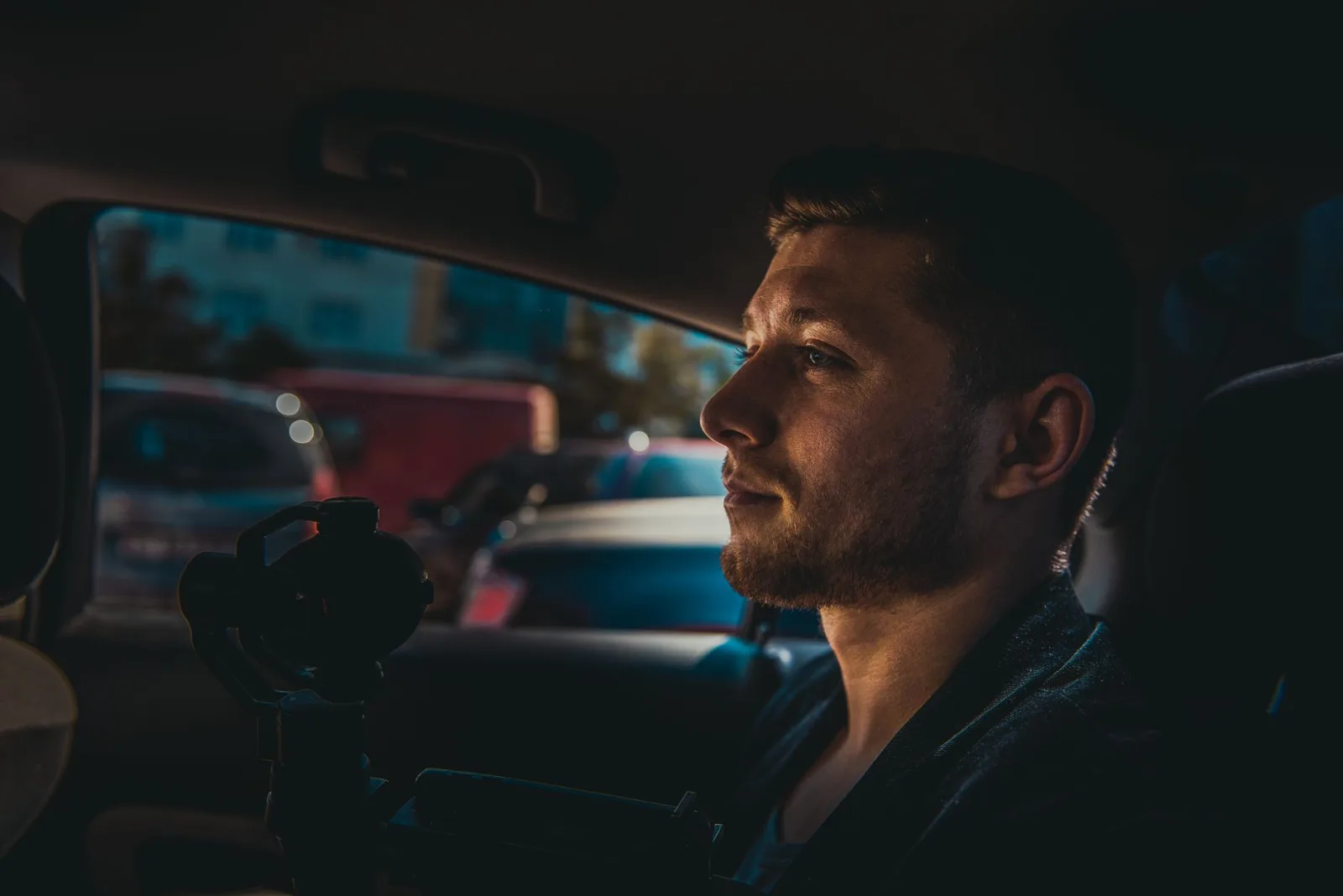
The next day he tried the car. He sat in the driver's seat and filmed, and the window came out white and blown while his face stayed dark, and the mic recorded the engine and the air conditioning.
A tight space is not a bad space. It is a space that takes three things from you, and each one has a fix.
What a tight space takes away
Distance. So you are forced onto a wide lens, and a wide lens close to a face enlarges what is in the middle and bends the edges.
Depth. The wall is right behind your back, so the picture becomes a single layer with no background.
Quiet sound. Sound bounces off the nearby walls, and in a car it bounces off the glass and mixes with a rumble.
Six fixes for a small room
1. Shoot along the diagonal. Do not put the camera in the middle of one wall and sit facing it; put it in a corner and sit in the opposite corner. The diagonal is the longest line in any room, and it buys you half a metre or more.
2. Put the camera in the doorway. One of the oldest fixes here: the camera in the room's entrance or slightly outside it, with you inside. You gain the whole depth of the doorway.
3. Get away from the back wall. One metre behind you changes the whole picture: the wall becomes less sharp and less lit, so you appear separated from it.
4. Use the longest lens the distance allows. Not the widest. 35mm is kinder to a face than 16, and 50 is kinder still if the distance allows. What each focal length decides is in One lens or two? How to choose the lens you will shoot most of your work on.
5. Light from one bounced source. In a small room light bounces off every wall, so the lighting goes flat. Use one source aimed at the ceiling or at a large sheet of white card, and switch the rest off. The logic of a single source in low light is in Filming in low light and at night.
6. Build depth with one light behind you. A small lamp on a shelf or in a corner behind you gives the picture a second layer, and it is enough for it to sit outside the frame or at its edge.
The frame: get closer rather than wider
A tight space punishes anyone trying to show the whole room. The answer is to tighten the frame rather than widen it: chest up, or the face alone.
And add something in the foreground: the edge of a door, a plant, the back of a chair at the frame's edge. A foreground creates depth where there is no background. The rules for where a face sits in the frame are in Composition and Framing: Where to Put Your Subject in the Frame?.
Sound in a small room
Three moves, in this order:
- Get the mic close. Distance settles more than any processing.
- Bring fabric in. A rug, a curtain, an open wardrobe outside the frame. An empty small room is worse than a furnished large one.
- Move away from hard corners. The corner where two bare walls meet is what rings most.
Inside a car
Safety first: park the car. Do not film while driving, do not adjust a setting while the car is moving, and do not hold a camera in one hand with the other on the wheel. A parked car in a safe place gives you the same shot with no risk, and in many countries using a camera or phone while driving is an offence.
After that, six rules:
| The issue | The fix |
|---|---|
| Camera position | A small mount on the dashboard at eye level, or a mount on the passenger seat |
| A blown-out window | Expose for the face rather than the window, shade the window, or shoot with the sun on the opposite side |
| A dark face | A sheet of white card on the passenger seat bouncing the window light back onto you |
| Sound | A mic on your shirt rather than the camera mic, with the air conditioning off while recording |
| Outside noise | Park away from the main road, and close the windows |
| Colour | Lock the white balance, since a car holds daylight, tinted glass and a lit dashboard |
A car has one advantage a room does not: its soft surfaces absorb sound, so the audio in it is cleaner than in many rooms once the engine and the air conditioning are off.
Settings in a tight space
- Do not open the aperture all the way. The distance is short so the depth of field is already shallow, and a wide-open aperture leaves your nose sharp and your eyes soft.
- Lock the white balance by numbers. A tight space mixes sources: a window, a ceiling light, a screen.
- An ND filter if the window is in the frame. It lets you lower the shutter speed without blowing out the outside.
- Check sharpness on your eyes, not on the wall. Autofocus in a tight space drifts between your face and the wall behind you.
A two-minute checklist
Before you record in any tight space, ask four questions:
- Am I on the diagonal or on the short wall?
- Is there distance between me and the back wall?
- Is the light coming from one source or three?
- Did I record ten seconds and listen on headphones?
Four questions in two minutes solve most of what ruins indoor filming.
And if this is your permanent spot
Turn the fixes into a fixed setup you rebuild in three minutes: floor marks, a settings card, and a box of tools beside it, with the method in A fixed filming corner at home: how do you set one up in an hour and lock its settings?.
And if you are filming yourself alone in that space, the focus and framing problem with nobody helping has its own checklist in How do you film yourself alone?.
In short
Do not wait for a bigger room. The diagonal, distance from the wall, the longest lens possible, and one source of light: four decisions that cost nothing and make a small room look like a place you chose rather than one you were stuck with.