
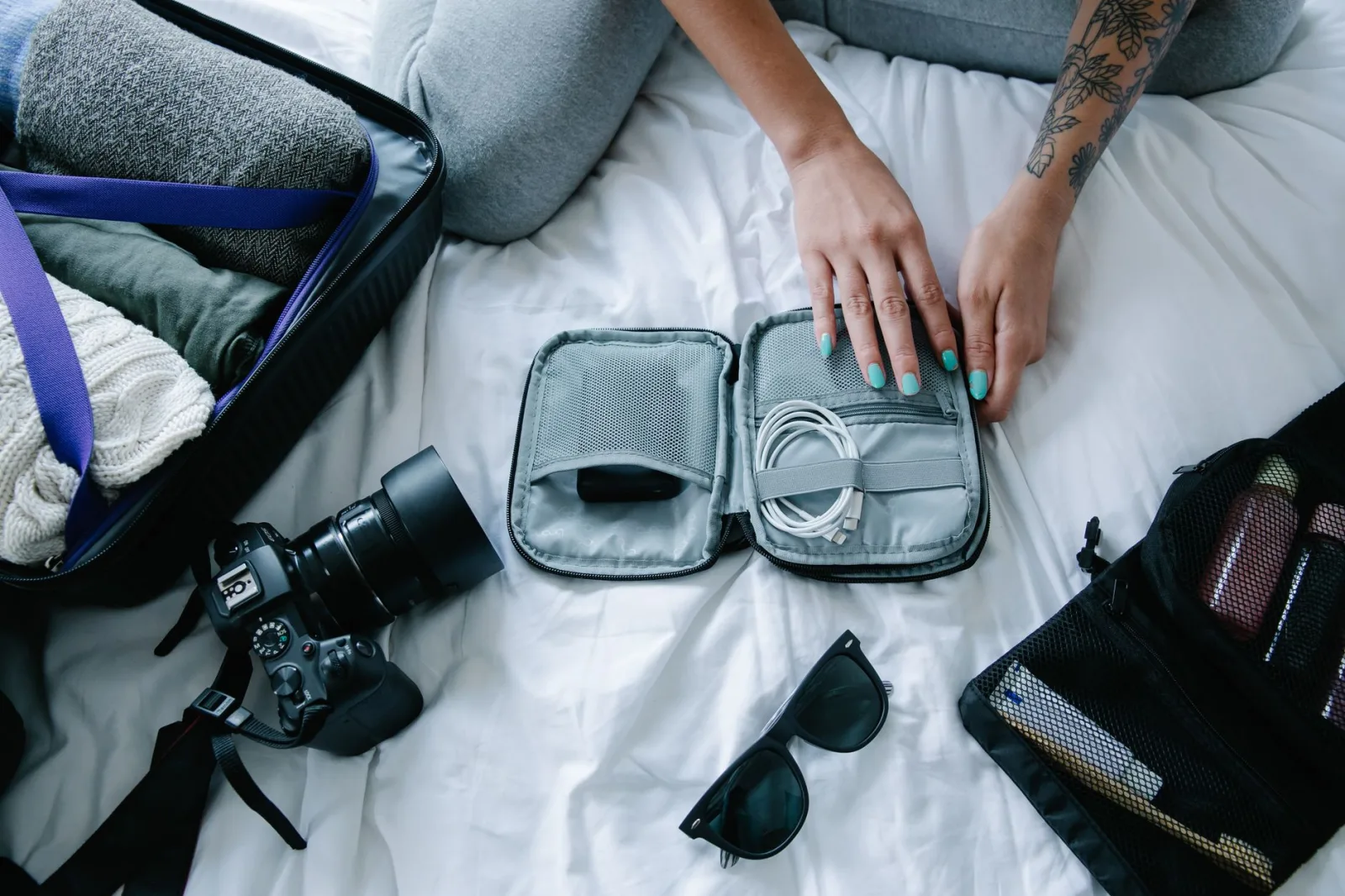
Airline and customs rules differ from country to country and from carrier to carrier, and they change. This article is a way of organising rather than a legal reference, so read your airline's page and the destination's customs site before every trip.
He landed after a nine-hour flight and stood at the baggage belt for forty minutes. The clothes bag arrived; the second bag, with the tripod and the lights in it, did not.
That would have been annoying rather than disastrous, except that he had put something else in that bag: his three batteries and the charger. So he had a camera and one half-full battery, with three days of filming ahead of him.
The bag arrived on the third day. The lesson is not that bags get lost, but that he had split his gear in a way that let one lost bag stop all the work.
The two-bag rule
Ask yourself one question before every trip: if one of my bags goes missing, can I still shoot?
If the answer is no, redistribute. The arrangement that holds:
| Cabin bag | Checked bag |
|---|---|
| Camera body and main lens | Tripod and stabiliser |
| All batteries and chargers | Lights and their stands |
| All memory cards | Spare cables and clamps |
| Drives holding filmed material | Cases and pouches |
| The main microphone | The backup microphone |
| The laptop | Filming clothes |
Putting the batteries and cards in the cabin is not only prudence: lithium batteries are generally not allowed in the hold, and that is an aviation rule rather than a choice.
Batteries: read before every trip
This is the item that stops people at screening more than any other, and its rules differ between carriers and change. The practical approach:
- Carry them all in the cabin bag, and put not one lithium battery in the checked bag.
- Insulate the terminals. Tape over the contacts, or each battery in its own pouch, since metal contact is the original reason for the restriction.
- Know your batteries' capacity. The figure is printed on the battery, and carriers' limits are based on it. Read your airline's page and screenshot it on your phone.
- A drone battery or a large power bank has tighter rules, and some require advance notice.
How many batteries you actually need, and which card to buy, we set out in Batteries and memory cards: what to actually buy.
Your footage on the way home
On the way out you carry gear; on the way home you carry something money cannot buy: your shots.
Three rules:
- Do not put all the material in one place. One copy on a drive in your cabin bag, and one copy on cards or a second drive somewhere else on you.
- Copy before you travel. The last night in the hotel is when the second copy gets made, not after you land.
- Do not wipe the cards until you are certain. A card with the material on it is cheaper than repeating the trip.
Customs: three things to prepare
Most travellers with one camera are never asked. The person who gets asked is the one carrying a bag that looks professional: a camera, two lenses, lights and a tripod.
Prepare three things, and they cover most situations:
1. A gear list with serial numbers. One page: the device's name and its number, photographed on your phone. It serves you at customs, with insurance, and with the police if something is stolen.
2. Receipts, or anything showing the gear is yours and not new. The point is for the officer to see you are not importing equipment to sell.
3. A short, clear answer. If you are asked the purpose of your visit, answer honestly and briefly in line with your visa. Do not launch into a long explanation, do not volunteer information nobody asked for, and do not say anything untrue.
Large gear that moves between countries for work has its own administrative system for temporary admission, and a freight company or a customs office in your own country is who to ask about it. As for the permissions covering the filming itself rather than the gear, that is another matter, set out in Filming permits when you travel.
And if you have a drone, that is the riskiest item in the whole bag, with rules that change from country to country, in Drones abroad: the rules change from country to country.
Insurance: what is covered and what is not
Ordinary travel insurance usually does not cover professional gear, or covers it with a very low ceiling.
Before paying for any policy, ask four direct questions: is gear covered in the checked bag? Is paid professional use covered? What is the ceiling per item? And is theft from a car or a hotel room excluded?
The exclusions are what matter, not the large number in the headline. And keep the gear list and the receipts, because there is no payout without proof of ownership.
Power and charging
A small item that ruins days:
- Plug type and voltage. A plug adaptor, and make sure your chargers accept the local voltage.
- A small power strip. The hotel room has two sockets and you are charging six things.
- A fixed nightly ritual. Everything charges at night in one place, so you never leave in the morning on a half-full battery.
The rest of what goes in the bag for each shoot day is in What do you carry in your camera bag?, and what you specifically need when you are alone is in Filming Alone in a Country You Don't Know.
The arrival checklist: half an hour on day zero
Before the first filming day, open everything in the room and test it:
- Switch the camera on, record ten seconds, and watch them.
- Try every battery in the camera, not only in the charger.
- Record with the mic and listen, because a damaged cable reveals itself here rather than in the interview.
- Open the tripod and check its screws, since screws work loose in transit.
- Copy a file from the card to the laptop, to confirm the card reader is with you and works.
Half an hour here saves a whole day. Gear that travels meets vibration, cold and heat, and protecting it in the field itself is in Filming in rain, dust and cold.
And the last rule: weight decides
Everybody who has travelled to film comes back with the same sentence: I carried more than I used.
Write your list, then cross off every item you did not use on your last two trips. What remains is your real kit, and the rest is weight you pay for twice: at the airport and in your back.