
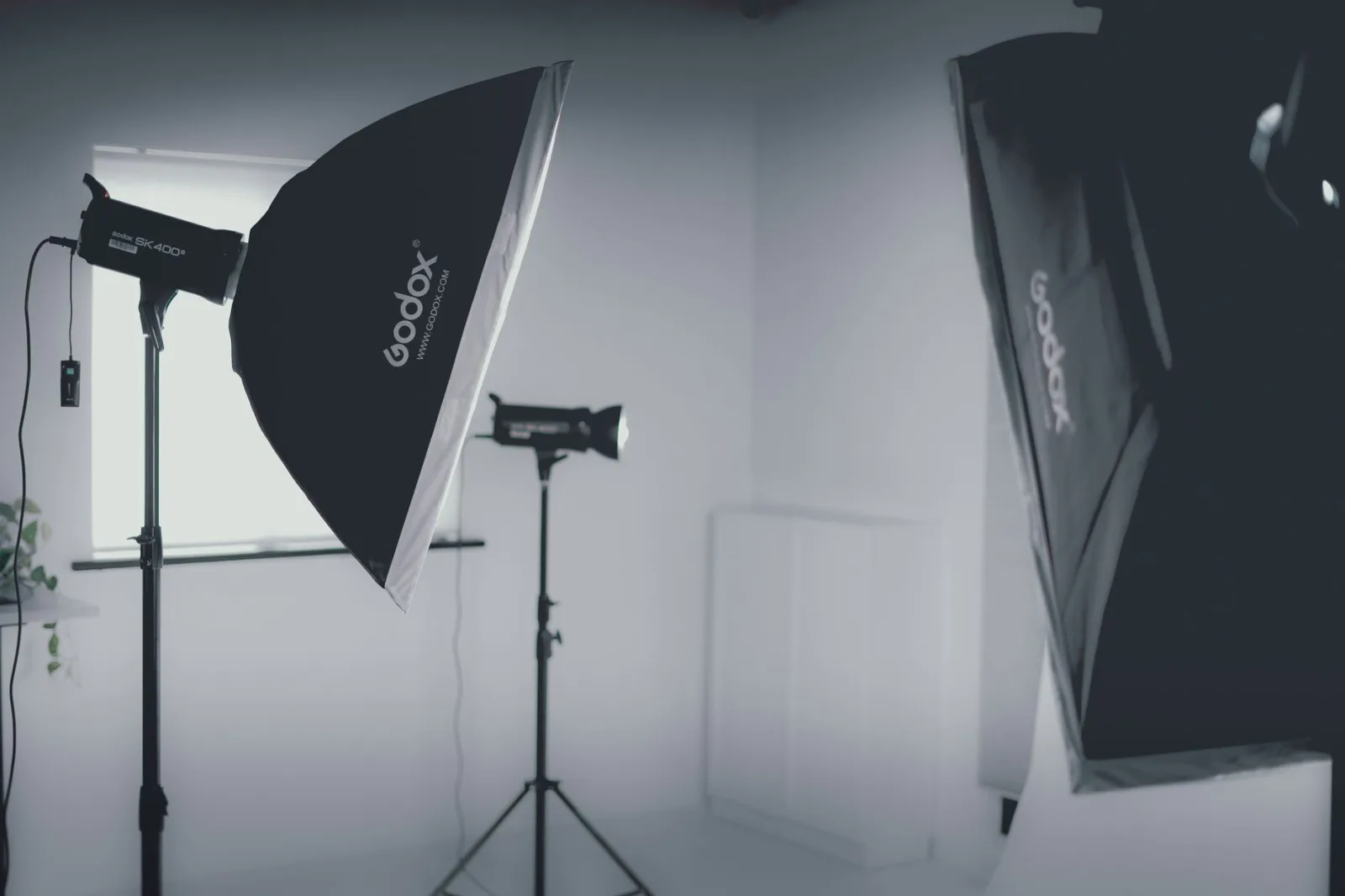
The first thing he bought was a ring light, because it is the first thing on every gear list. He filmed with it, and his face came out flat with no shadow, the ring was reflected in his glasses, and the wall behind him was completely dark.
A month later, without spending anything, he moved his desk a metre so the window was on his left. He filmed, and the picture was better than everything he had shot with the lamp.
That is the lesson that saves a beginner their first three purchases: lighting is not a device you buy but a direction you understand. Understanding the direction is covered in Lighting in Filming: From a Single Source to Three-Point Setups; this article is about the gear rather than the method.
Three free things before any purchase
- A window beside you rather than in front of or behind you. Side light makes features, front light flattens them, back light turns your face into a shadow.
- A white surface on the other side. A sheet of card, a foam board, even a bedsheet. It returns light to the shadowed side and softens the hard shadow.
- Switch off the ceiling light. The lamp in the middle of the ceiling is the worst light in the house, because it comes straight down onto the top of your head.
Whoever does all three before buying knows what they are actually missing, and buys nothing they do not need.
The buying order
| Order | What you buy | Why it sits here |
|---|---|---|
| 1 | One strong lamp with a large diffuser | Solves ninety percent of light problems |
| 2 | A solid stand, ideally with a heavy base | A lamp that falls breaks itself and whatever is under it |
| 3 | A reflector, or a cheap white board | Gives you a second source with no second price |
| 4 | A small lamp for the background or hair | Separates you from the wall so the picture has depth |
| 5 | A neutral density filter if you shoot outdoors | Lets you control exposure in sunlight |
Everything after that can wait: coloured lamps, light tubes, effects. Those are style tools rather than light tools, and whoever buys them before the first and second items ends up with a colourful bad picture.
What actually matters in a lamp
Five things; the rest is marketing detail:
- Dimming. A lamp with one setting has to be moved away until it works, so you lose control.
- A large diffuser. Look at the diffuser's measurements rather than the power number.
- A stable colour temperature. A lamp whose colour shifts as you dim it gives every shot a different colour and makes life hard in Colour correction in the edit.
- Power source. Mains at home, battery outdoors. The best lamps take both.
- Silence. Some lamps have fans you can hear in the microphone, a problem you only notice after filming.
Do not go by the big numbers on the box. A medium-power lamp with a wide diffuser beats a powerful bare one.
Diffuser size matters more than lamp power
This is the most important sentence here. Soft light comes from a source that is large relative to your face, not from one that is strong.
A very small lamp, however bright, gives a hard shadow and harsh edges. The same lamp behind a piece of white cloth or a sheet of paper becomes a wide source, and the whole picture softens.
The cheapest experiment you can run today: put a translucent white sheet between your lamp and your face, and move the lamp closer. The result is worth more than buying a more expensive unit.
Ring lights: when they work
They work for one thing: a face close to the camera in a tight space with no time to set up. They fail in two cases: if you wear glasses, and if you want a picture with shadow and depth.
If you already own one, do not throw it out. Put it to the side at forty-five degrees instead of straight in front of you, and the picture improves immediately.
And if you film on a phone
The logic does not change. A phone benefits from good light more than a large camera does, because its sensor is smaller so low light shows noise quickly. All the phone's limits are in Can You Create Professional Content With Just a Phone?
And before a lamp, buy a microphone
If you have money for one thing, make it sound rather than light. A viewer tolerates a mediocre picture and will not tolerate bad audio for two minutes, and the order for choosing a mic is in The Best Microphones for Filming on a Phone.
Then make lighting the second purchase, and put it in your budget as in How do you budget a video and decide what to buy?
Safety and power
- Do not put a lamp on a light stand above anybody's head without weight on the base.
- Lamps get hot, so leave a gap between them and any cloth or paper you use as a diffuser, and never leave them on while you are out of the room.
- One power strip for everything is a route to trouble. Spread the load, and run cables along the wall rather than across the middle of the floor.
- When travelling, check the mains voltage and plug type before carrying a mains-powered lamp.
A test before you buy the second one
Before buying a second lamp, film a minute with your one lamp in three positions: in front of your face, at forty-five degrees, and fully to the side. Then add the white sheet on the opposite side.
If one of those pictures pleases you, you do not need a second lamp; you need a stand that holds the first one in place. The full relationship between light, aperture and sensitivity is in Camera Basics and the Exposure Triangle.
In one line: use the light you already have before buying light, then buy one lamp with a big diffuser, then buy nothing until you can name the problem you are missing a tool for.